
 Sebastian Stokkendal
In This Article▼
Customers rarely interact with a business through just one channel. A person might discover a product through social media, receive a welcome email after subscribing, visit a website, and later receive a text message about an unfinished purchase. Each interaction contributes to the overall customer experience.
The challenge is making these interactions feel connected rather than repetitive. When a business sends an email and a text message without considering what the customer has already received, its marketing can quickly become intrusive. Customers may see the same offer twice, receive reminders after completing a purchase, or get promotional messages that have little relevance to their interests.
This is where the message handoff becomes an important concept. It refers to the planned transition between communication channels, allowing a business to use email and SMS according to customer behaviour, preferences, urgency, and the purpose of a message.
A successful approach does not involve sending every message through every available channel. Instead, it gives each channel a distinct role and determines when another channel should take over.
For businesses investing in customer acquisition and retention, the message handoff offers a way to create more organised customer journeys. It helps marketers deliver detailed information through email, use text messaging for timely interactions, and coordinate follow ups around what customers actually do.
What Is the Message Handoff in Marketing?
The message handoff is the deliberate transfer of a communication task from one channel to another based on a defined customer action, event, or business requirement.
For example, a customer might receive an email containing detailed information about a product launch. If the customer has opted in to marketing texts and a deadline is approaching, the business might send a short SMS reminder with a direct link to the offer.
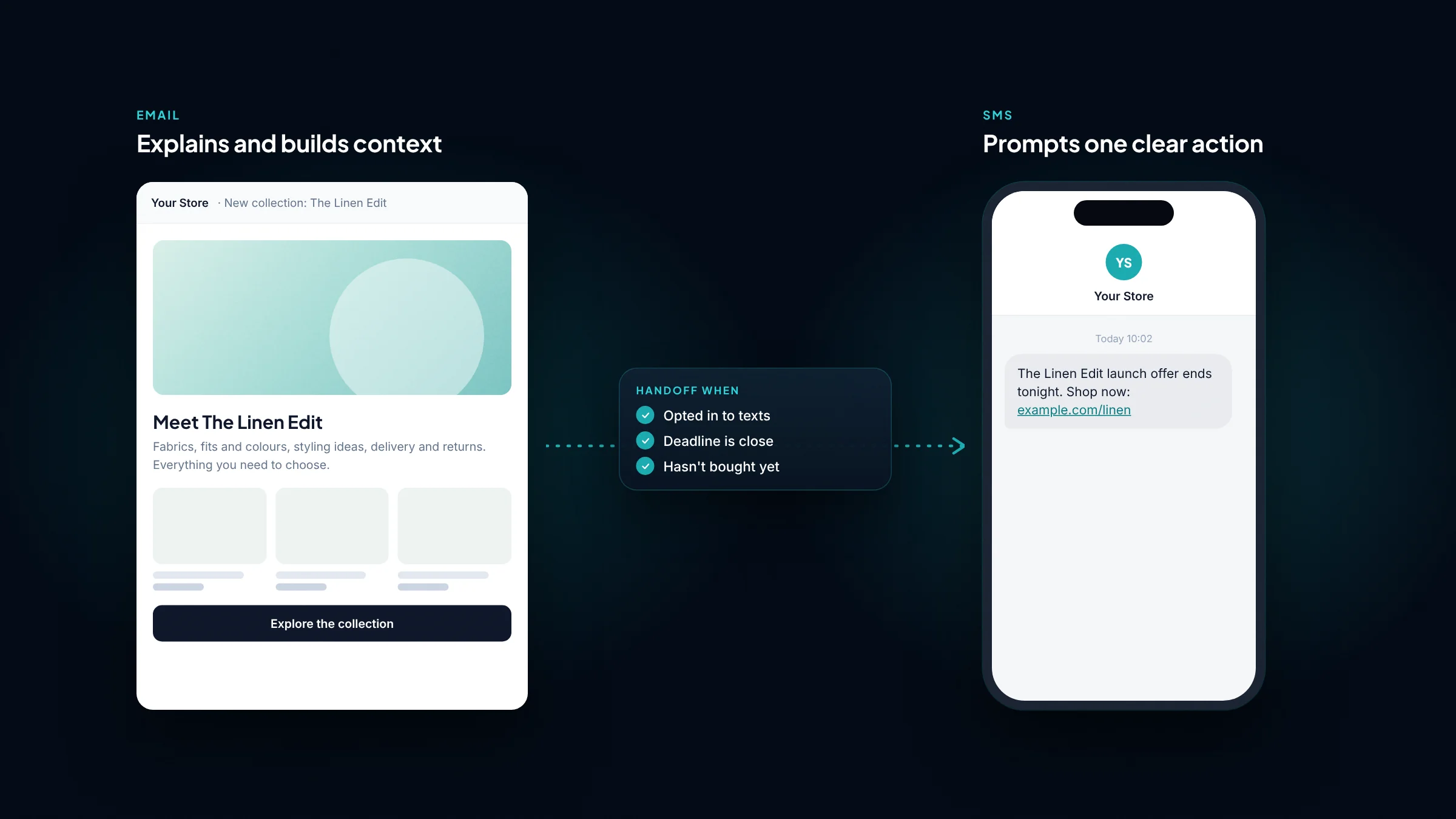
The two messages serve related purposes, but they do not need to repeat the same content. Email provides room for product details, images, explanations, and multiple links. SMS can highlight an important deadline, confirm an appointment, or invite the customer to take one clear action.
A handoff can also move in the opposite direction. A customer might initially receive a text about an appointment, then receive an email containing preparation instructions, directions, or a detailed confirmation.
The important distinction is that the channels work together according to a plan. Each communication has a reason for being sent, and the next step depends on the customer's journey rather than a fixed schedule alone.
Why Businesses Need a Connected Email and SMS Strategy
Email and SMS offer different strengths. Email is suitable for detailed information, newsletters, product education, onboarding instructions, and content customers may want to revisit. Text messaging is useful for concise reminders, time sensitive updates, and conversations where a short response can resolve a question.
Problems arise when businesses treat both channels as interchangeable broadcasting tools.
Imagine a customer has already purchased an item after receiving an email promotion. If the same customer receives a text urging them to complete that purchase, the communication reveals that the business has failed to account for the customer's behaviour.
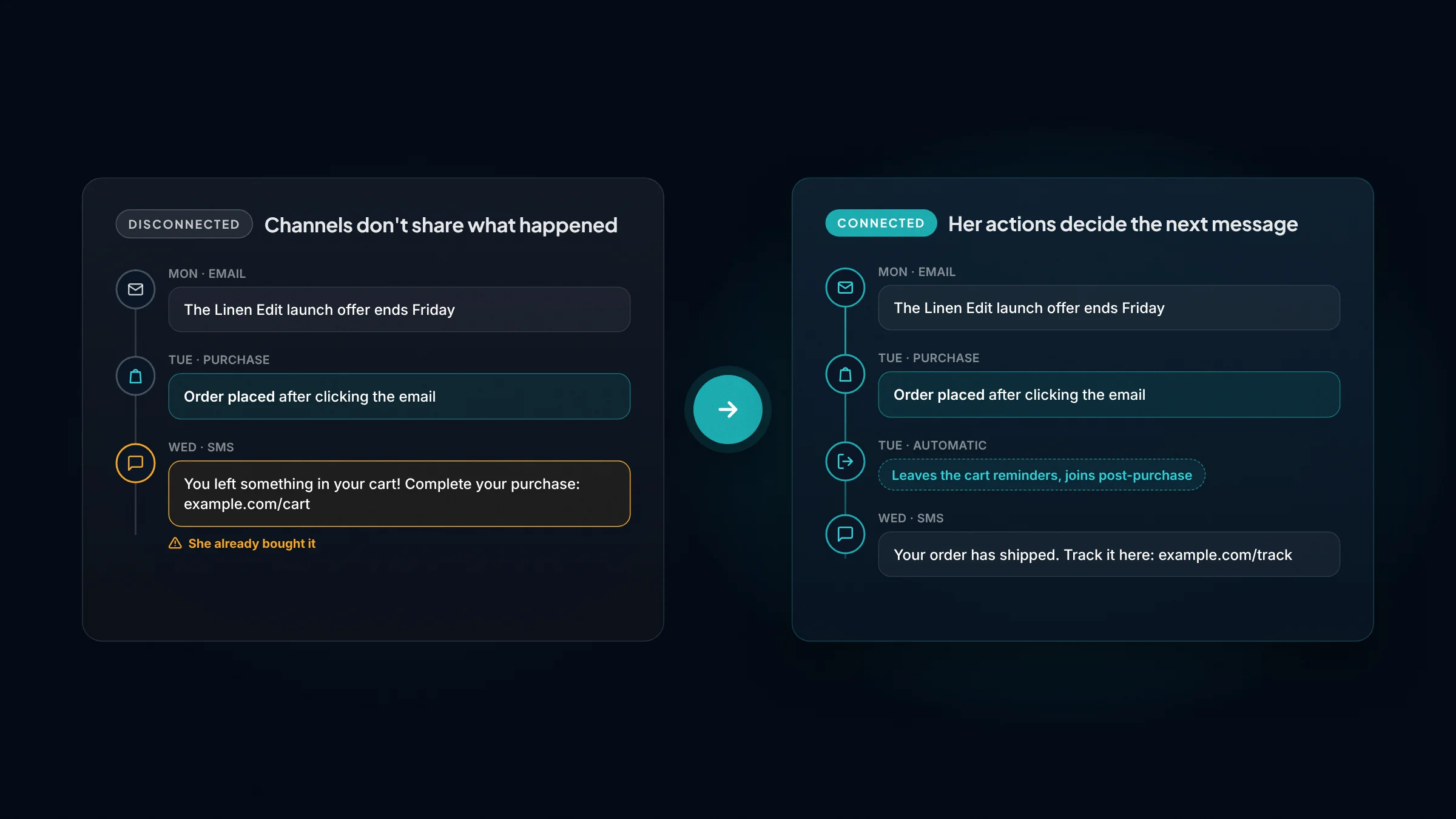
The same problem can occur when someone books a consultation but continues receiving messages encouraging them to book one. Even if the individual messages are well written, the overall experience feels disconnected.
A coordinated approach uses customer actions to determine what happens next. Purchasers can leave an abandoned cart sequence, booked customers can enter a confirmation journey, and people who have already received a requested answer can stop receiving redundant reminders.
In practice, the message handoff helps marketing teams move away from channel based scheduling and towards customer centred communication.
What the Statistics Reveal About Email and SMS
Industry research demonstrates why businesses should consider both channels while recognising that performance varies by audience, campaign type, and measurement method.
The Data and Marketing Association's Email Benchmarking Report 2025 analysed anonymised performance data from seven email service providers. It reported a delivery rate of 98% in 2024, rising to 99.2% in the business to consumer sector. The report also recorded a unique click rate of 2.3%.
These figures show why email delivery and engagement should be assessed separately. A message reaching an inbox does not guarantee that a recipient will click, read the content carefully, or complete a purchase.
SMS research also provides useful context. EZ Texting's 2026 Consumer Texting Behavior Report found that 89% of surveyed US consumers had subscribed to business texts, while 87% checked a new text within 15 minutes.
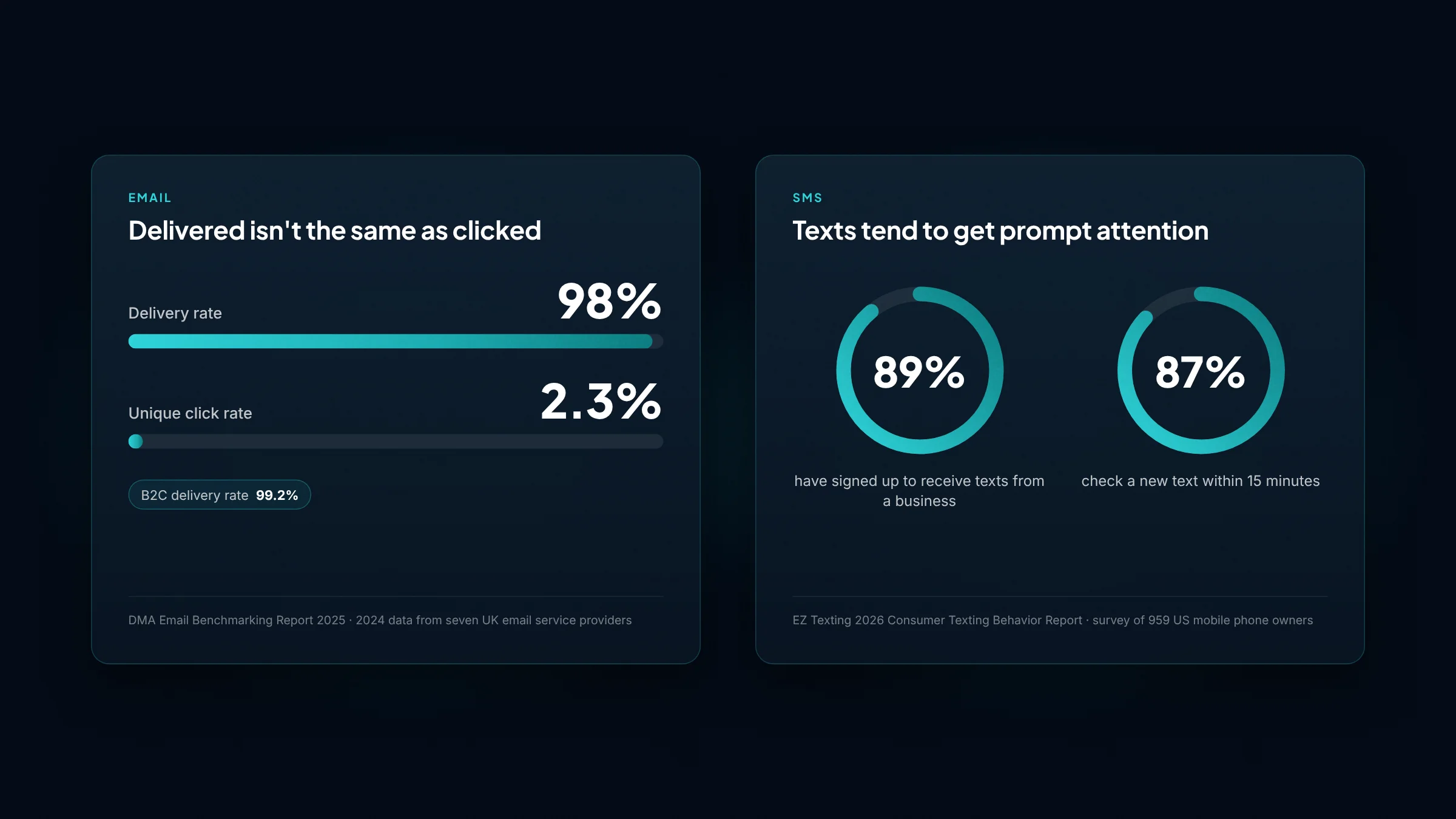
These findings suggest that text messaging can be useful when information needs prompt attention. However, they do not mean that every SMS should be sent immediately or that every customer prefers texts for every interaction.
The opportunity lies in matching the channel to the task. Email can explain, educate, and build context. SMS can prompt a timely action when the customer has given the appropriate permission.
How Email and SMS Should Work Together
1. Use email for detailed information
Email is often the better starting point when customers need to understand a product, compare options, or review information before making a decision.
An online retailer launching a new collection could send an email featuring product images, descriptions, pricing, and styling suggestions. A professional services business might send an email explaining its process, answering common questions, and introducing its team.
This format gives recipients space to explore the offer at their own pace.
If a follow up is necessary, marketers should first consider whether the customer engaged, clicked a link, completed a purchase, or requested additional information. A later SMS should add something useful rather than simply reproduce the original email.
2. Use SMS for timely actions
Text messaging can be appropriate when the customer needs a concise reminder or a convenient way to respond.
Examples include appointment confirmations, delivery updates, booking reminders, limited time offers, and requested information about a service.
A fitness studio might send an email explaining its membership options, then send a text to a subscribed prospect who has requested a trial session. The text could provide the next booking step without repeating the entire membership explanation.
The timing and content should reflect the customer's situation. Businesses must also respect consent, applicable communication laws, and reasonable contact frequency.
3. Let customer behaviour determine the next message
A connected journey should respond to what the customer does.
If a recipient purchases after an email promotion, the promotional sequence should stop and the customer should enter an appropriate post purchase journey. If the customer clicks a product link but does not buy, the business might provide useful additional information before considering a relevant follow up.
If someone books an appointment, the system should send confirmation rather than another invitation to book.
This is the practical value of the message handoff. It creates continuity between interactions while reducing the likelihood that customers receive irrelevant communications.
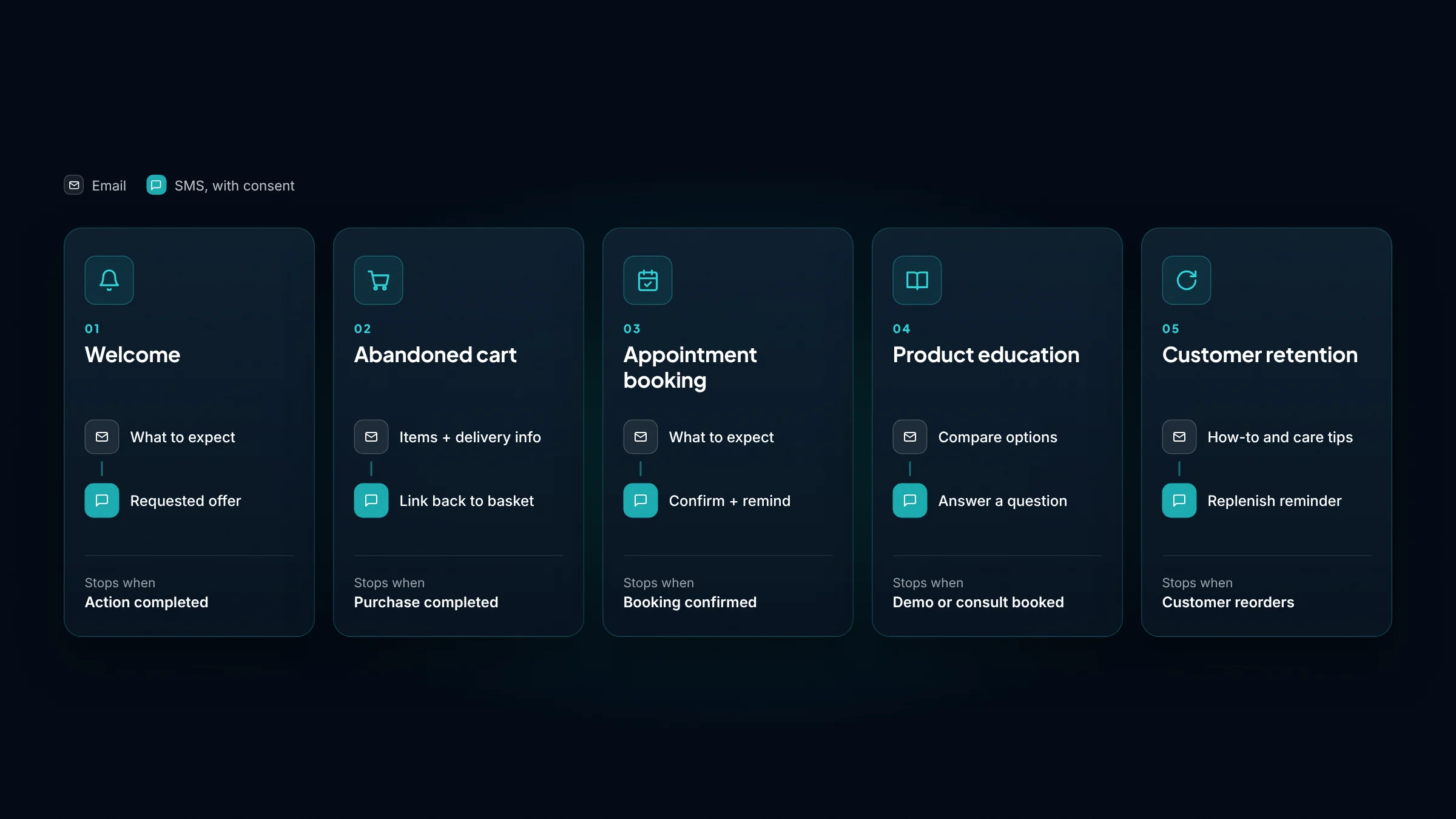
Five Email to SMS Journeys Businesses Can Build
1. The welcome journey
When someone subscribes to a mailing list, an immediate welcome email can explain what the business offers, introduce its products, and clarify what the subscriber can expect.
If the person has separately provided the appropriate consent for marketing texts, the business may use SMS for a relevant next step, such as notifying the subscriber about a requested offer or reminding them about an upcoming event.
The journey should not assume that subscribing to email automatically grants permission for promotional text messages.
A practical welcome sequence might include the following stages.
- Send a welcome email with useful introductory information.
- Allow the subscriber time to explore the content.
- Evaluate relevant behaviour, such as a product click or a request for further details.
- Send a suitable SMS only when the subscriber has the necessary consent and the message provides additional value.
- Stop the promotional journey when the intended action is completed.
2. The abandoned cart journey
An abandoned cart occurs when a shopper adds items to an online basket but leaves without completing the purchase.
An email can remind the customer about the selected products and provide useful information about delivery, returns, or product features. If the customer has opted in to marketing texts, a later SMS may offer a concise reminder with a direct link back to the basket.
The sequence should account for customer behaviour. Once a purchase is completed, the remaining promotional reminders should stop.
Businesses should also avoid assuming that every abandoned basket represents lost revenue. Some customers are browsing, comparing prices, waiting for payday, or simply using a cart to save products.
The purpose of a follow up is to make it easier for an interested customer to continue, not to pressure every visitor into buying.
3. The appointment booking journey
Service businesses can use email and SMS to guide prospects from an initial enquiry to a completed appointment.
An email might explain the service, introduce the professional handling the appointment, and provide information about what to expect. A text can then confirm the booking or send a timely reminder.
If a prospect has not completed a booking, a relevant follow up may invite them to choose an available time. Once the appointment is confirmed, promotional booking messages should stop.
The sequence can continue after the appointment with a useful email containing next steps or a request for feedback. Any request for a review should be genuine and should follow the applicable rules for customer reviews.
4. The product education journey
Some purchases require more consideration than others. Customers buying software, specialist equipment, expensive home products, or professional services may need time to understand the available options.
An email sequence can introduce the product, explain its benefits, answer common questions, and help readers compare suitable choices.
If a customer asks for additional information by text, the business can respond directly or provide a relevant resource. A later message might invite the customer to a demonstration or consultation if that step matches the person's expressed interest.
This approach makes the message handoff useful beyond immediate promotions. It supports the decision making process by delivering information in a format appropriate to each stage.
5. The customer retention journey
Marketing should not end when a customer completes a purchase. Existing customers may benefit from product guidance, maintenance reminders, replenishment notices, relevant upgrades, or invitations to return.
An email can provide detailed advice on using a product effectively. An SMS may be appropriate for a short reminder about a service appointment or a replenishment deadline, provided the customer has consented where required.
Businesses should avoid sending repeated discount offers simply because a customer has purchased before. Retention messaging works best when it reflects the product, the customer's needs, and the expected timing of another interaction.
How to Build a Message Handoff Workflow
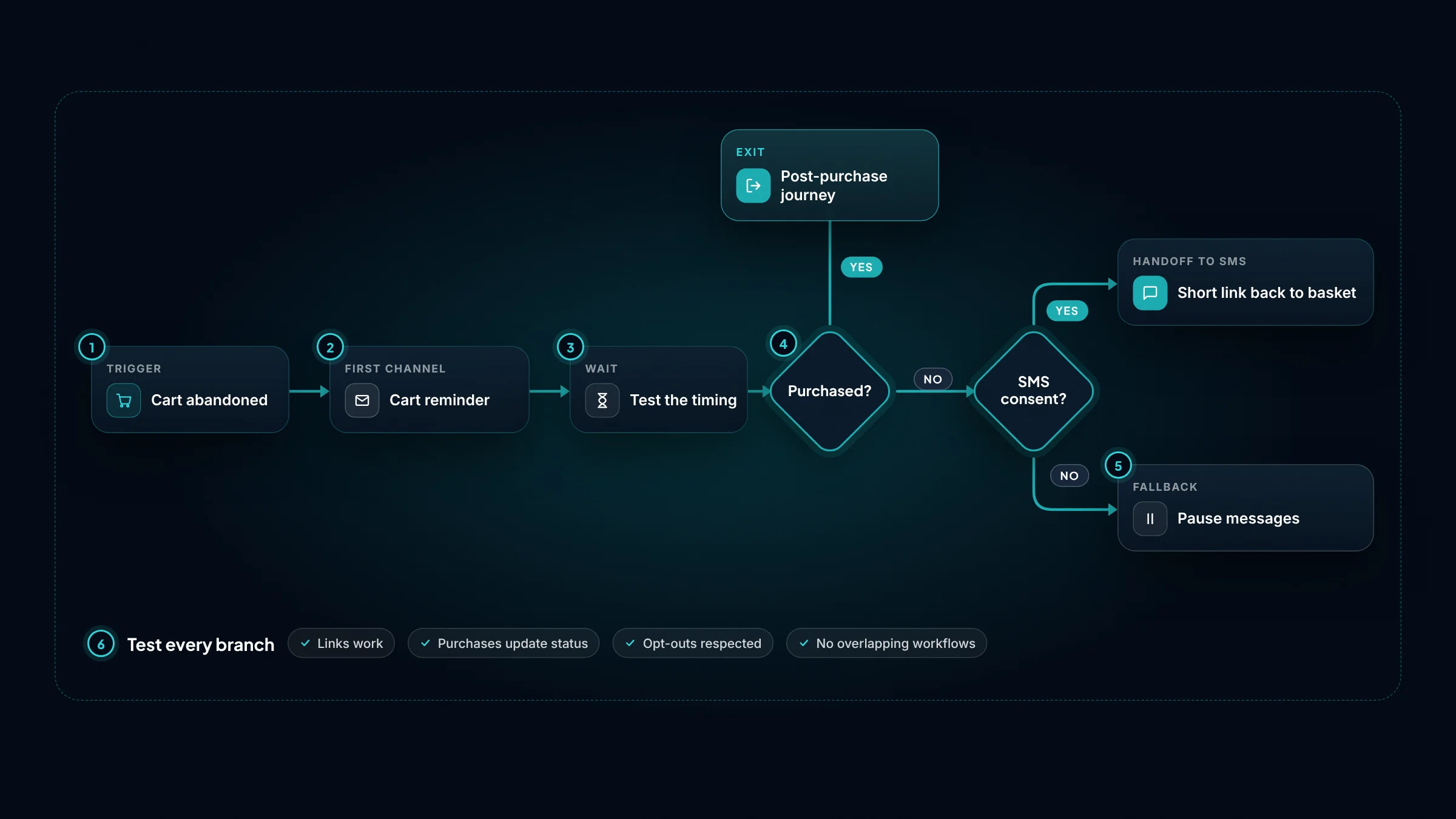
A successful workflow begins with a clear objective. Before choosing a sequence of emails and texts, marketers should decide which customer outcome they want to support.
Step 1: Define the trigger
A trigger is the event that starts a workflow. It could be a new subscription, an abandoned basket, a product enquiry, a completed purchase, or an appointment booking.
The trigger should represent a meaningful customer action rather than an arbitrary date alone.
Step 2: Choose the first channel
Determine whether email or SMS is the most suitable starting point. Consider the information required, the urgency of the communication, the customer's preferences, and the available consent.
Detailed educational content will often suit email. A short confirmation or urgent reminder may suit SMS.
Step 3: Set the waiting period
A delay gives customers time to act before receiving another communication. The appropriate interval depends on the purpose of the message, the customer journey, and the urgency of the situation.
For example, an appointment confirmation may be needed immediately, while a product education sequence may allow several days between messages.
There is no universal timing rule that works for every business. Test reasonable intervals and review the results.
Step 4: Add behavioural conditions
A workflow should respond to changes in customer status.
If a customer purchases, stop abandoned cart promotions. If a customer books an appointment, move them into the confirmation sequence. If a customer unsubscribes, ensure the relevant promotional messages stop.
Conditions prevent a workflow from continuing after its original purpose has been fulfilled.
Step 5: Define the fallback
A fallback is the next appropriate action when the expected event does not occur.
If a customer does not click an email, the business might wait and provide a different piece of useful information. If a text requires a response that an automated system cannot handle, it should be directed to an appropriate team member.
A fallback should not automatically mean sending more messages. Sometimes the right decision is to pause communication.
Step 6: Test the entire journey
Before launching a workflow, test each branch using sample customer records. Confirm that links work, messages display correctly, purchase events update the customer status, and opt out requests are respected.
Also check that customers do not enter overlapping workflows that send conflicting messages.
How to Prevent Customers From Feeling Overwhelmed
Even a technically sophisticated marketing system can produce a poor customer experience if it sends too many messages.
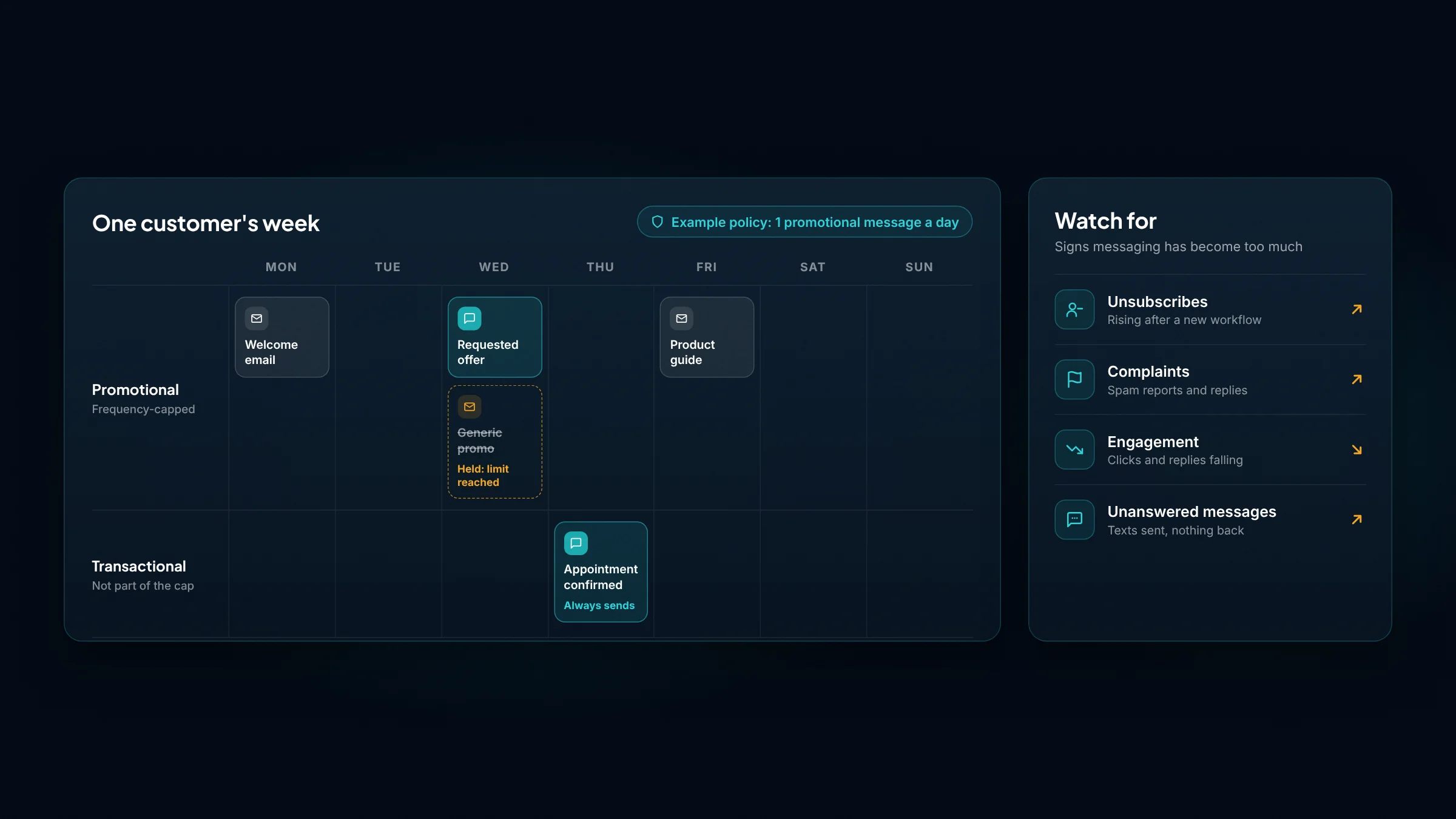
The first priority is to create a clear contact policy. Decide how often customers may receive promotional emails and texts, how urgent messages are handled, and how different workflows interact.
Next, use frequency controls to prevent customers from receiving multiple promotional communications within a short period. A customer who is already receiving a welcome series may not need to receive a separate generic promotion on the same day.
Businesses should also distinguish transactional messages from promotional communication. An appointment confirmation serves a different purpose from an offer encouraging a new purchase. The applicable consent and legal requirements may differ, so companies should verify the rules for the jurisdictions in which they operate.
Another important practice is to make preferences easy to manage. Customers should understand what they have subscribed to and have a straightforward way to withdraw consent where required.
Finally, monitor negative signals such as unsubscribes, complaints, declining engagement, and repeated unanswered messages. These indicators can reveal when communication has become excessive or irrelevant.
Metrics That Show Whether Your Strategy Works
The success of the message handoff should be measured across the complete customer journey rather than by the performance of each message in isolation.
| Metric | Why it matters |
|---|---|
| Email delivery rate | Indicates how many emails were accepted for delivery |
| Email click rate | Shows whether recipients interact with links |
| SMS response rate | Measures the proportion of messages that receive responses, using a consistent definition |
| Conversion rate | Shows how many recipients complete the intended action |
| Time to conversion | Helps identify how long customers need to progress |
| Unsubscribe rate | Signals whether communication may be irrelevant or excessive |
| Revenue per recipient | Helps evaluate commercial value |
| Incremental conversion lift | Estimates the additional outcomes caused by a campaign |
Use consistent definitions across campaigns. For example, an SMS response rate should specify whether automatic replies, opt out messages, and customer service responses are included.
Email open rates also require careful interpretation because privacy features and automated image loading can affect measurement. Clicks, conversions, and controlled experiments often provide more actionable evidence.
Where possible, use a holdout group that does not receive the additional message. Comparing its results with those of the campaign group can help determine whether the extra SMS genuinely improves outcomes.
Common Mistakes to Avoid
A connected email and SMS strategy can fail when businesses overlook basic planning.
- Sending the same promotion through both channels without a clear reason.
- Treating an email subscription as permission to send marketing texts.
- Continuing abandoned cart messages after a customer completes a purchase.
- Creating workflows without exit conditions or frequency controls.
- Measuring clicks and opens without connecting them to meaningful outcomes.
- Assuming every customer wants the same communication frequency.
- Using automation without testing message content, links, timing, and customer status updates.
Avoiding these mistakes helps businesses create communication that feels coordinated, relevant, and respectful.
How Messaro Makes Connected Marketing Easier
Building the message handoff into everyday marketing does not need to involve complicated software or a collection of disconnected tools.
At Messaro, we bring email marketing, SMS marketing, automation, analytics, and AI assistance together in one platform. Our tools help businesses create campaigns, organise customer segments, and build workflows that respond to customer actions.
Our automation builder supports workflows involving triggers, conditions, delays, and AI assisted actions. Businesses can use these capabilities to design welcome sequences, lead qualification processes, follow ups, and other customer journeys suited to their goals.
With our AI Copilot, marketers can draft messages, develop campaign ideas, create automation workflows, and prepare content that reflects their brand guidelines. Our analytics tools help businesses review campaign activity, including clicks and responses, so they can make more informed decisions about their communication strategy.
Our platform also provides an inbox for managing SMS replies, so the team can keep text conversations organised instead of leaving them on one person's phone. Two-way email conversations are on the way.
Whether you are running an online store, managing a service business, or building a growing brand, we aim to make coordinated customer communication more accessible and manageable.
Messaro offers a free plan, allowing businesses to explore the platform before deciding whether to upgrade. Start with a simple customer journey, measure its performance, and improve it as you learn more about your audience.
With a thoughtful strategy and the right tools, your email and SMS campaigns can work together to provide a better customer experience while supporting sustainable business growth.
Frequently Asked Questions
What is the message handoff in email and SMS marketing?
The message handoff is the planned transition between email and SMS based on a customer's behaviour, preferences, or a specific event. It allows each channel to serve a distinct purpose within a connected customer journey.
Should a business send the same message through email and SMS?
Not by default. Email is generally better suited to detailed information, while SMS can be useful for concise reminders and timely actions. Messages should complement one another and reflect the customer's current situation.
How can businesses prevent customers from receiving too many marketing messages?
Businesses can establish frequency limits, coordinate overlapping workflows, use customer behaviour to stop irrelevant messages, respect communication preferences, and honour opt out requests. Regular monitoring helps identify when messaging becomes excessive.
How does Messaro support email and SMS automation?
Messaro brings email marketing, SMS campaigns, automation workflows, analytics, and AI assistance together on one platform. Text replies are handled in an SMS inbox. Two-way email conversations are on the way. These features help businesses coordinate customer communications, manage SMS replies, and evaluate campaign performance.