 Sebastian Stokkendal
In This Article▼
I have spent a lot of time talking to businesses about email and SMS marketing, and there is one assumption I keep seeing: "If we send more emails, we will make more sales."
It sounds logical. More messages mean more opportunities to sell, right? Not necessarily. I believe this is one of the most damaging assumptions a growing business can make about email marketing. More sending does not necessarily mean more sales.
Email can be an incredibly powerful revenue channel, but its returns vary. In a 2025 survey of nearly 500 marketing professionals, Litmus found that 35% reported earning $10 to $36 for every $1 invested in email, 30% reported $36 to $50, and 5% reported more than $50. These are reported survey results, not a guaranteed ROI for every business. The lesson from the Litmus email marketing ROI research is not to increase volume blindly. It is to become better at sending the right message to the right person at the right time.
More Emails Can Create Less Engagement
Imagine subscribing to a clothing brand because you like its products. The first few emails are useful. You discover new collections, receive a discount, and see products that match your interests.
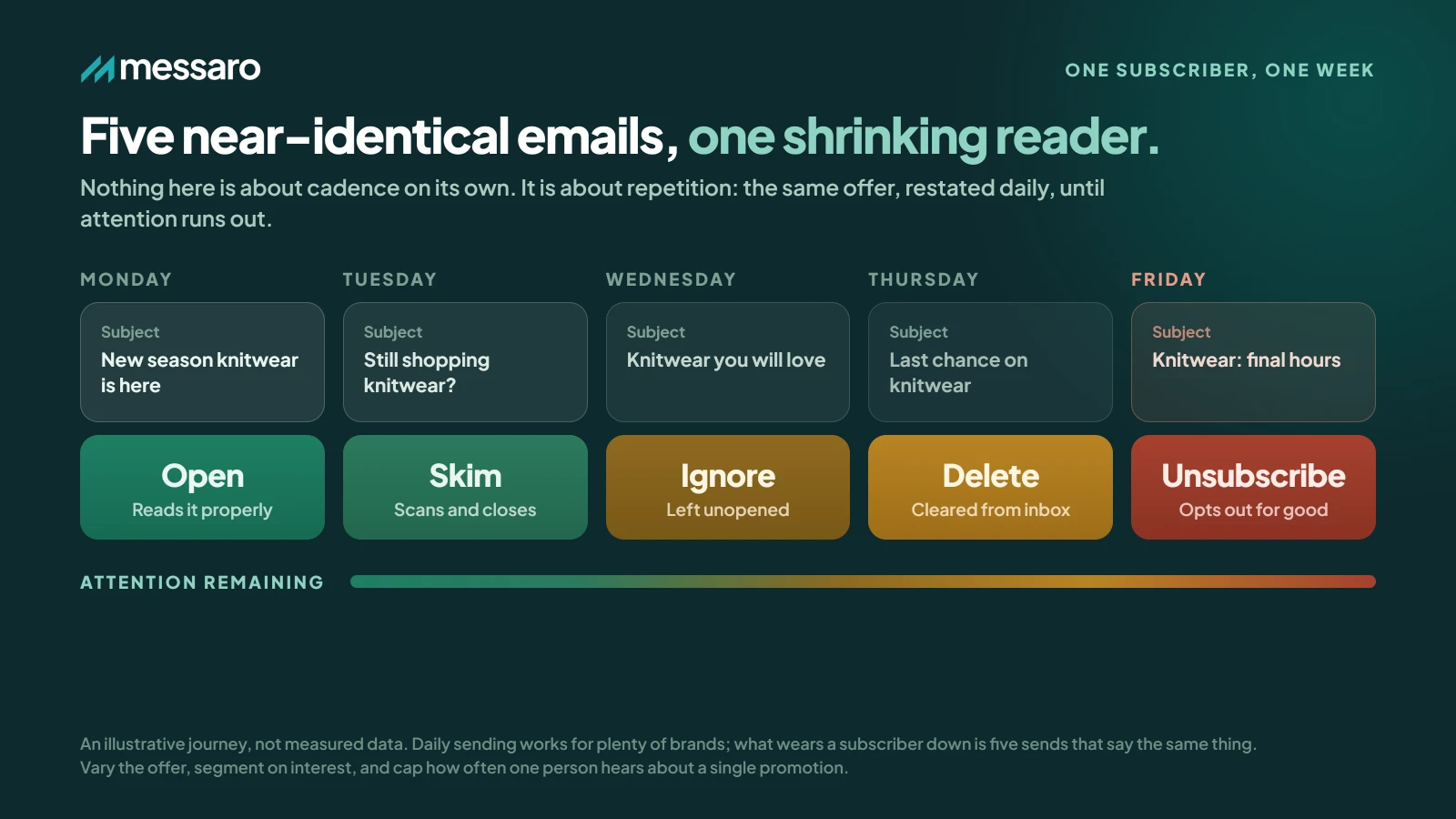
Then the brand starts emailing you every day. Monday brings a sale. Tuesday brings another sale. Wednesday says, "Don't miss out." Thursday offers another discount, and Friday introduces a weekend promotion. Eventually, you stop opening. Then you start deleting. Perhaps you unsubscribe. The business increased its email activity, but it did not necessarily strengthen its relationship with you.
MailerLite's 2026 benchmark draws on more than 3.6 million campaigns from 181,000 approved accounts, covering December 2024 through November 2025. It found an overall median unsubscribe rate of 0.22%, versus 0.08% in its prior benchmark. MailerLite says easier Gmail unsubscribe controls likely contributed to the change. The figures do not show that sending frequency alone caused it. Cadence still needs to be evaluated by audience, industry, content quality, consent, and customer expectations. The broader point in the MailerLite email benchmark is that subscribers have limited attention. For practical cadence guidance, see how often to send marketing emails.
The Question Should Not Be “How Many Emails Can We Send?”
At Messaro, I encourage businesses to ask a different question: "What does this customer actually need from us right now?" That question changes everything because each lifecycle moment calls for a different response.
- A new subscriber: A welcome sequence can introduce the brand and set useful expectations.
- An abandoned-cart shopper: A timely reminder can help them return to products they considered.
- A previous customer: A complementary product recommendation may be more useful than a generic promotion.
- A loyal customer: Early access to a new collection can recognize an established relationship.
- A long-inactive contact: A focused reactivation campaign can test whether they still want to engage.
These are completely different situations, yet many businesses use the same strategy for all of them: send another promotional email to everyone. That is where email marketing becomes inefficient.
Email Is Not a Megaphone
I think of email as a communication channel, not a megaphone that should keep getting louder. The objective is not to make the inbox busier. It is to make each communication more valuable.
HubSpot reports that 93.2% of surveyed marketers said personalized or segmented experiences led to more leads or purchases, while only 12.6% said they used hyper-personalization. This is survey evidence about marketers' reported experience, not proof that personalization causes the same result for every business. Still, the gap in the HubSpot marketing industry trends report is revealing. Businesses recognize the value of relevance, but many are not using the data they already have effectively.
Quality Beats Quantity
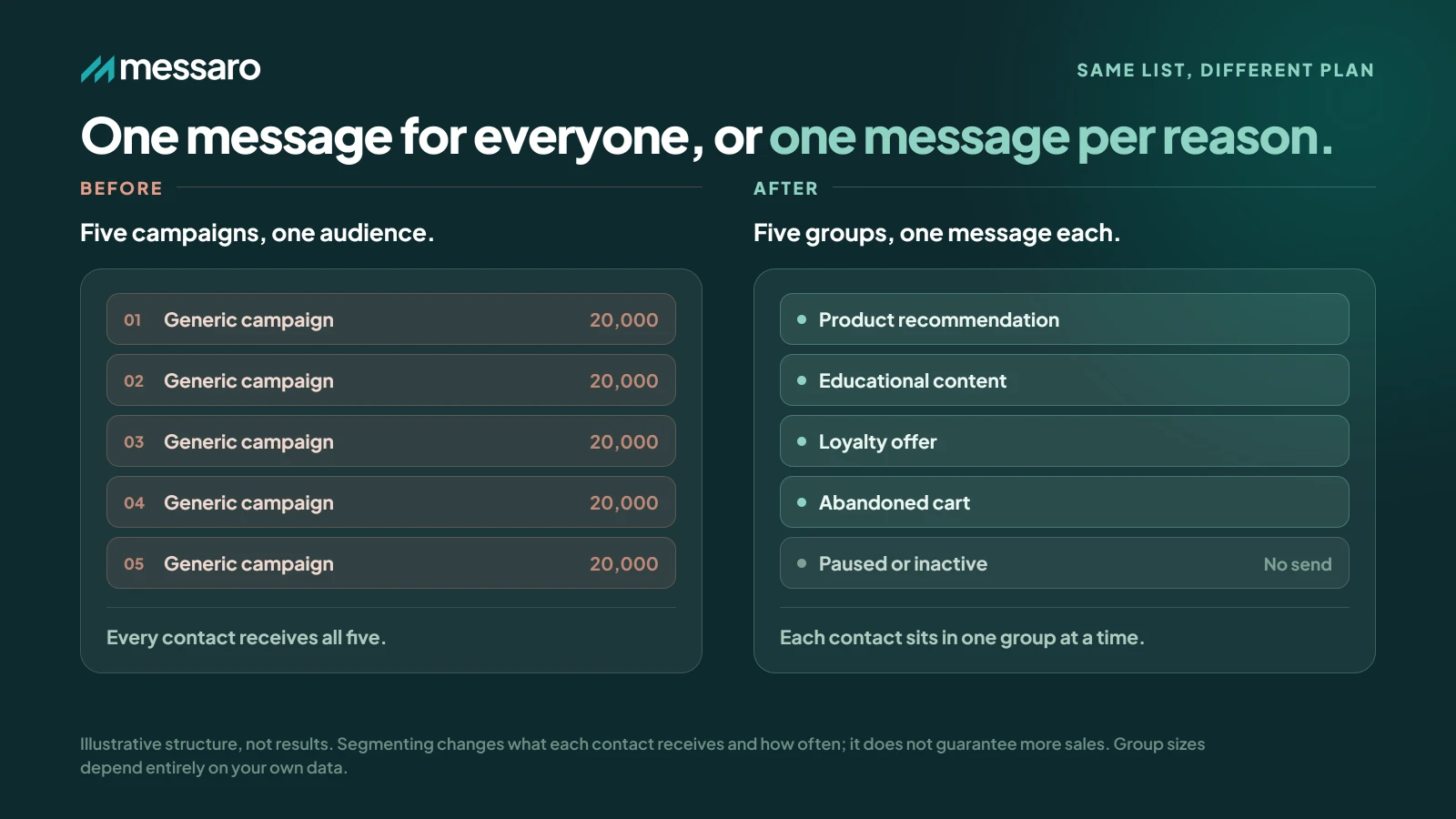
Suppose a business has 20,000 subscribers. It could send five generic campaigns to every contact each week, creating 100,000 deliveries. That looks impressive on paper. But if only 15% of subscribers are genuinely interested in the promoted products, much of that activity spends attention on people who may not care.
Now imagine that the company segments those 20,000 contacts by purchase behavior, interests, engagement, lifecycle, and previous interactions. Instead of asking how to send five emails this week, the team asks which customers need which message. One segment receives a product recommendation, another receives educational content, another receives a loyalty offer, and another receives an abandoned-cart reminder. An unengaged segment receives nothing for now. Sometimes the smartest email is the one you do not send. This is central to effective ecommerce email marketing.
Automation Changes the Equation
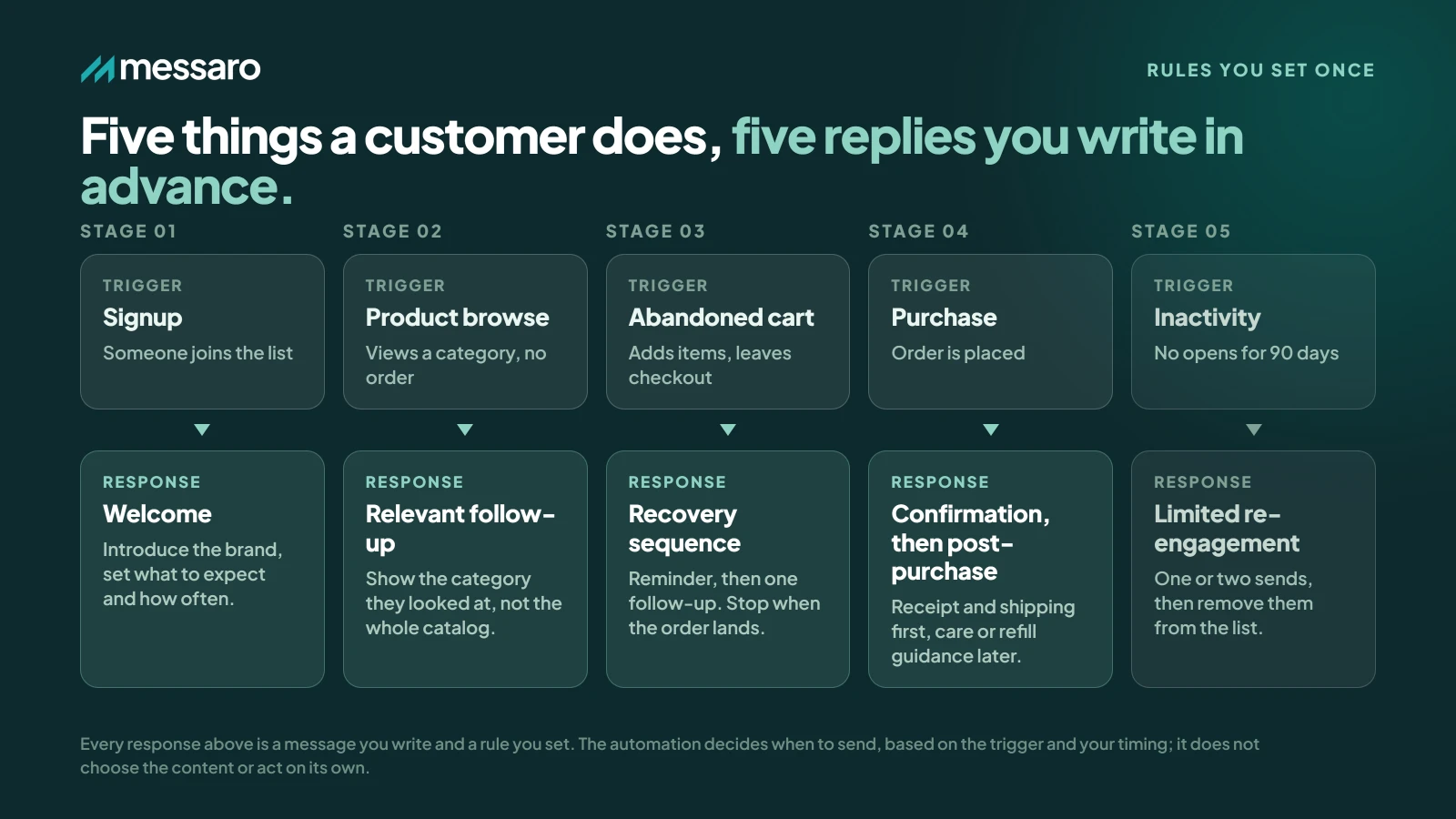
Not every email needs to be manually scheduled as a weekly broadcast. Some of the most useful communications can be triggered by customer behavior. A signup can start a welcome message. A product browse can lead to a relevant follow-up. An abandoned cart can start a recovery sequence. A purchase can lead to confirmation and post-purchase communication. Inactivity can trigger a carefully limited re-engagement campaign.
This creates a customer journey instead of a collection of disconnected promotions. Across its ecommerce dataset of more than 20 billion campaign emails and 470 million automated sends from 27,000-plus brands during 2025, Omnisend found that automated messages generated 22 times more revenue per sent email and converted at roughly 19 times the rate of campaign messages. Triggered messages likely differ in customer intent and timing, so the Omnisend email benchmark does not prove automation alone caused the lift. It does show why marketers should investigate timing and intent instead of treating volume as the main lever.
A Messaro Apparel Example: From Campaigns to Customer Journeys
One boutique apparel ecommerce brand working with Messaro had approximately 15,000 contacts, a cart abandonment rate around 70%, and less email engagement than it expected. The easy answer would have been more promotional campaigns. Instead, the strategy focused on behavior.
The brand connected its Shopify store with Messaro and introduced abandoned-cart triggers. Customers who left products behind could receive a coordinated email and SMS sequence instead of being treated like anonymous names on a list. The team also added segmentation and automated discount codes where appropriate.
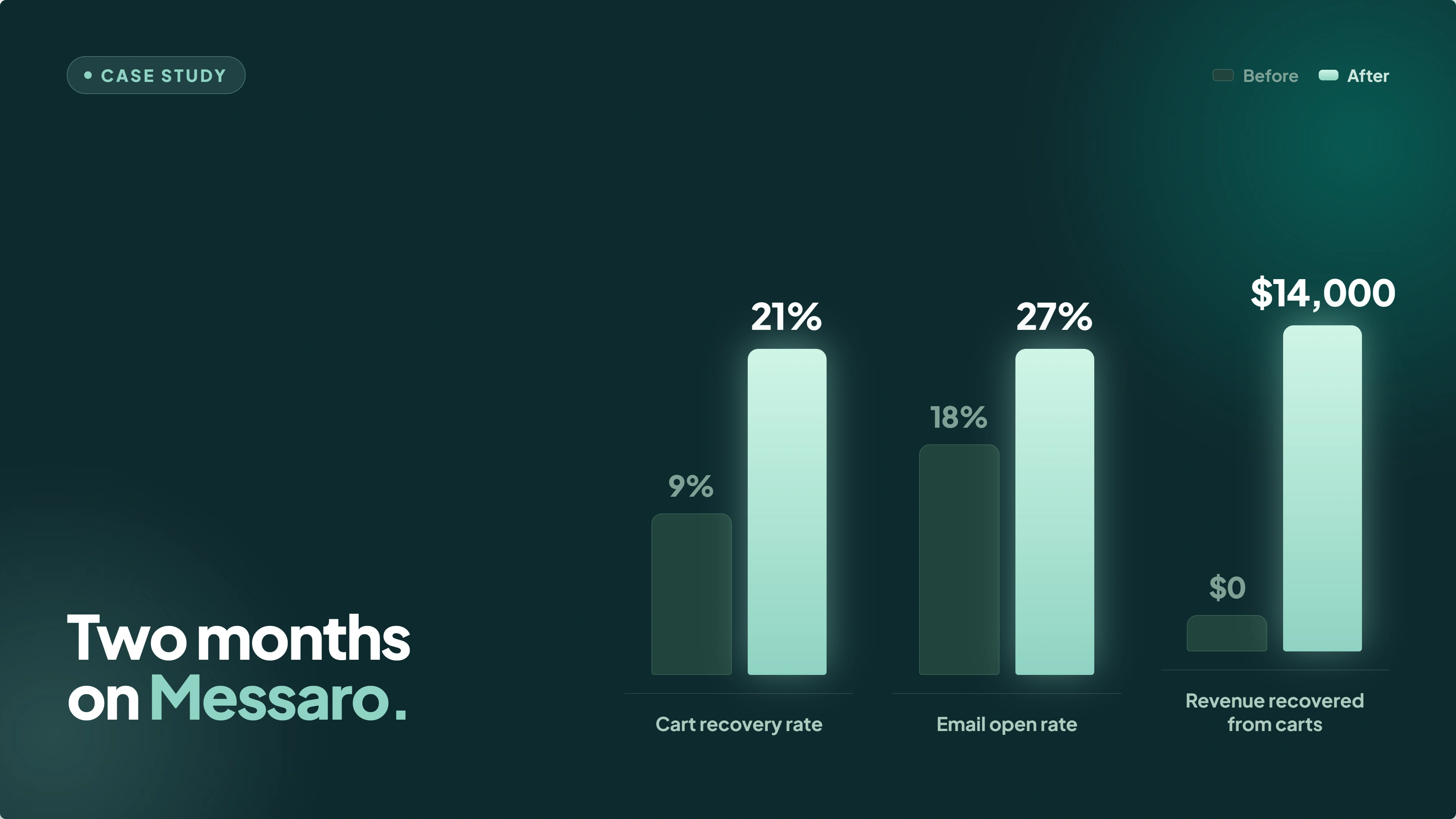
Its cart recovery rate increased from 9% to 21%, email open rates rose from 18% to 27%, and the program recovered about $14,000 over two months. Opens are only directionally useful because privacy protections can distort them, so the recovery and revenue figures provide important context. This is one individual example, not a promised outcome for another business. The lesson is that this brand made its existing communication more relevant instead of simply increasing frequency.
A Real-Estate Example: Re-Engagement Instead of More Promotions
A regional real-estate brokerage had 1,800 cold leads. A traditional approach might have kept sending promotions and hoped someone eventually responded. Instead, the company used focused SMS re-engagement with AI-assisted messaging and a process for managing replies.
The outreach generated 78 replies within 72 hours, followed by three closed sales that quarter. This is an individual case study, not a guarantee of replies or sales for another business. What matters is not only the number of messages sent. It is the conversation that happened because the outreach gave people a relevant reason and an easy way to respond. Marketing is not only about sending. It is also about listening.
Email and SMS Should Work Together
Businesses do not need to treat email and SMS as separate worlds. They can play complementary roles. Email suits longer communication, product discovery, newsletters, education, promotions, and storytelling. SMS suits short, timely reminders and conversations where immediacy matters.
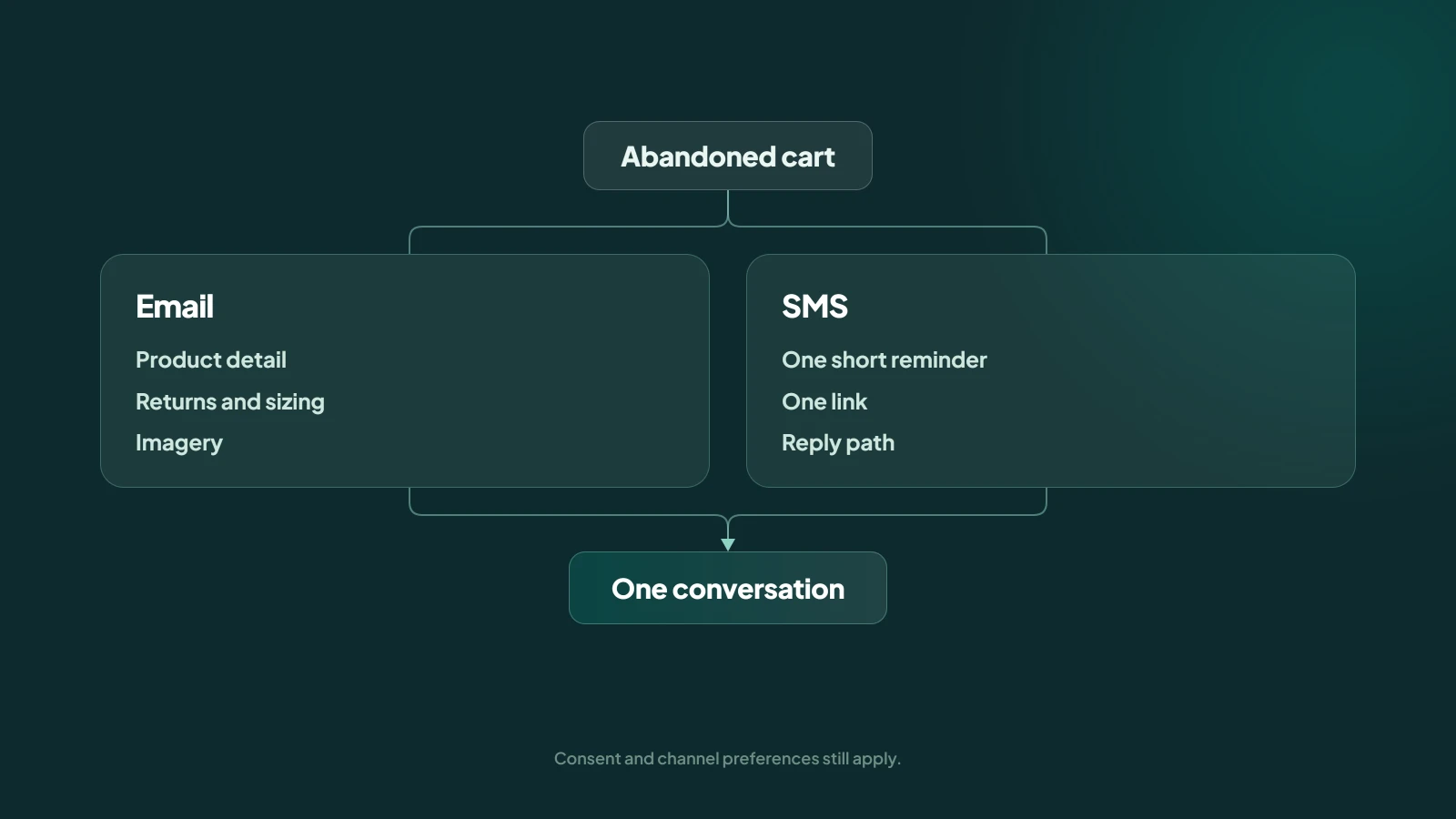
For an abandoned cart, email can provide product details and reassurance while SMS provides a concise reminder. If the customer replies by text, the conversation can continue. That is different from blasting the same promotion through every channel. The objective is a connected customer experience in which each channel has a clear job.
Messaro brings email, SMS, campaigns, templates, segmentation, automations, analytics, A/B testing, shared conversations, and AI-assisted copy and marketing capabilities into one platform, with WhatsApp coming soon. These tools can help teams coordinate their work, but they do not guarantee revenue or replace consent, strategy, and human judgment.
What Should Businesses Measure Instead?
If more emails are not the goal, I would start with five measures that show whether the communication is actually useful.
- 1. Revenue per send: Measure how much revenue each campaign or journey produces, not only how many messages were delivered.
- 2. Engagement quality: Treat opens as directional because privacy protections can inflate or distort them. Give more weight to clicks, replies, conversions, purchases, and downstream behavior.
- 3. Unsubscribe rate: If frequency rises alongside unsubscribes, examine relevance, expectations, consent, and audience fatigue rather than assuming any single cause.
- 4. Journey performance: Compare welcome flows, abandoned carts, post-purchase sequences, and re-engagement journeys using conversions, revenue per send, replies, and unsubscribes.
- 5. Customer lifetime value: One purchase is not the whole relationship. Look at repeat purchases, retention, and long-term value to understand whether the program supports durable customer relationships.
Reports
Campaign performance and analytics
142
Total created
512,480
Total sent
98,240
Total received
19.2%
Average
Performance by Type
Response rates by campaign type
Response Trends
Performance over time
Top Performing Campaign
Best based on response rate
Summer Kickoff
March 5th, 2026
25.7%
Response Rate
12,480
Sent
3,210
Responses
99.2%
Delivery
SINGLE
Type
The Future Is Better Timing, Not More Messages
I believe the next stage of email and SMS marketing will be less about sending more and more about applying customer context. AI can assist marketers with analyzing information and drafting copy. Automation can handle repetitive workflow steps. Segmentation can become more precise, and message variations can better reflect different customer groups. Any output still needs reliable data, defined rules, and human review.
None of that changes the fundamental principle: a relevant message beats a frequent one. The strongest marketers will not necessarily be the companies sending the most emails. They will be the companies that understand when a customer is likely to value contact, what that customer needs, and which communication is most useful. Teams considering AI-assisted workflows can also read about LLM-powered email marketing.
My Advice to Businesses Using Email Marketing
If your email strategy is not producing the results you want, do not immediately increase sending frequency. Start with the data. Who are your customers? What have they purchased? What interests have they shown? Which emails earn clicks, replies, conversions, or purchases? Where do people stop responding? Which journeys produce revenue? Which segments are over-contacted?
Then build around those answers. A practical guide to using email marketing to grow your business can help organize that process. Messaro's role is to provide infrastructure for email, SMS, campaigns, templates, segmentation, automations, analytics, A/B testing, shared conversations, and AI-assisted marketing, with WhatsApp coming soon. The software helps teams execute their strategy, while people remain responsible for accuracy, permission, audience fit, and decisions.
Final Thoughts
Businesses do not need another way to make more noise. They need better ways to understand customers and communicate intelligently. More emails give you more sends. Better marketing can create better conversations, and better conversations can create opportunities for sales without promising that every message or program will do so.
The goal is not maximum volume. It is relevant communication, useful timing, thoughtful channel choice, and measurement that connects each send to the customer journey.