
 Sebastian Stokkendal
In This Article▼
Getting a customer to respond to a marketing message is a meaningful achievement. It shows that the person noticed the communication, found something relevant, and decided to engage. However, a reply does not automatically translate into a sale. Many businesses generate enquiries through text messages but struggle to turn those conversations into paying customers.
This is where the SMS reply gap becomes important. It describes the distance between receiving a response from a potential customer and successfully moving that person towards a purchase, appointment, booking, or another meaningful business outcome.
Imagine an online store sending a promotional text about a limited time discount. A customer replies to ask whether the offer applies to a particular product. The marketing team receives the response several hours later, by which time the customer has purchased from a competitor. The original campaign generated interest, but the business failed to capitalize on it.
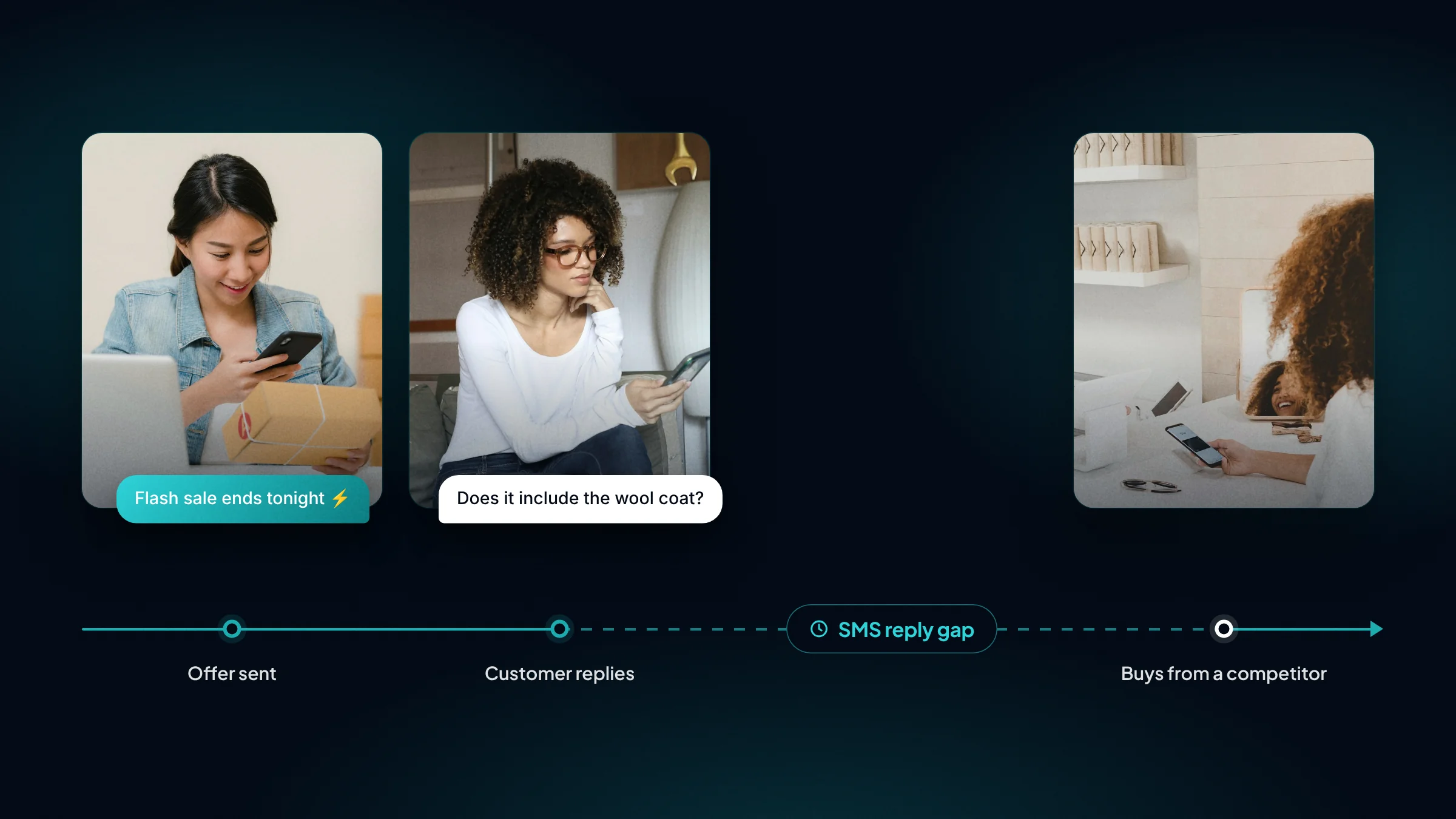
Similar situations occur in property agencies, fitness studios, educational businesses, professional services, and many other industries. Companies often concentrate on sending more messages without building a reliable process for managing the conversations that follow.
Understanding the SMS reply gap helps businesses shift their attention from message delivery to customer progress. Instead of asking how many people received a campaign, they can investigate what happened after a person responded and identify the obstacles preventing conversions.
What Is the SMS Reply Gap?
The SMS reply gap is the operational and communication gap between a customer responding to a business text and the business taking the appropriate next action.
That action could involve answering a product question, confirming an appointment, qualifying a sales lead, providing a payment link, resolving a concern, or arranging a consultation.
The gap can occur at several points in the customer journey. A message may receive a reply, but nobody notices it. An employee may see the response but lack the information required to answer. A qualified lead may receive a reply but never get a second follow up. Alternatively, the conversation may continue without a clear next step.
These situations have one thing in common. The business has already earned the customer's attention, yet its internal processes prevent that attention from becoming a useful outcome.
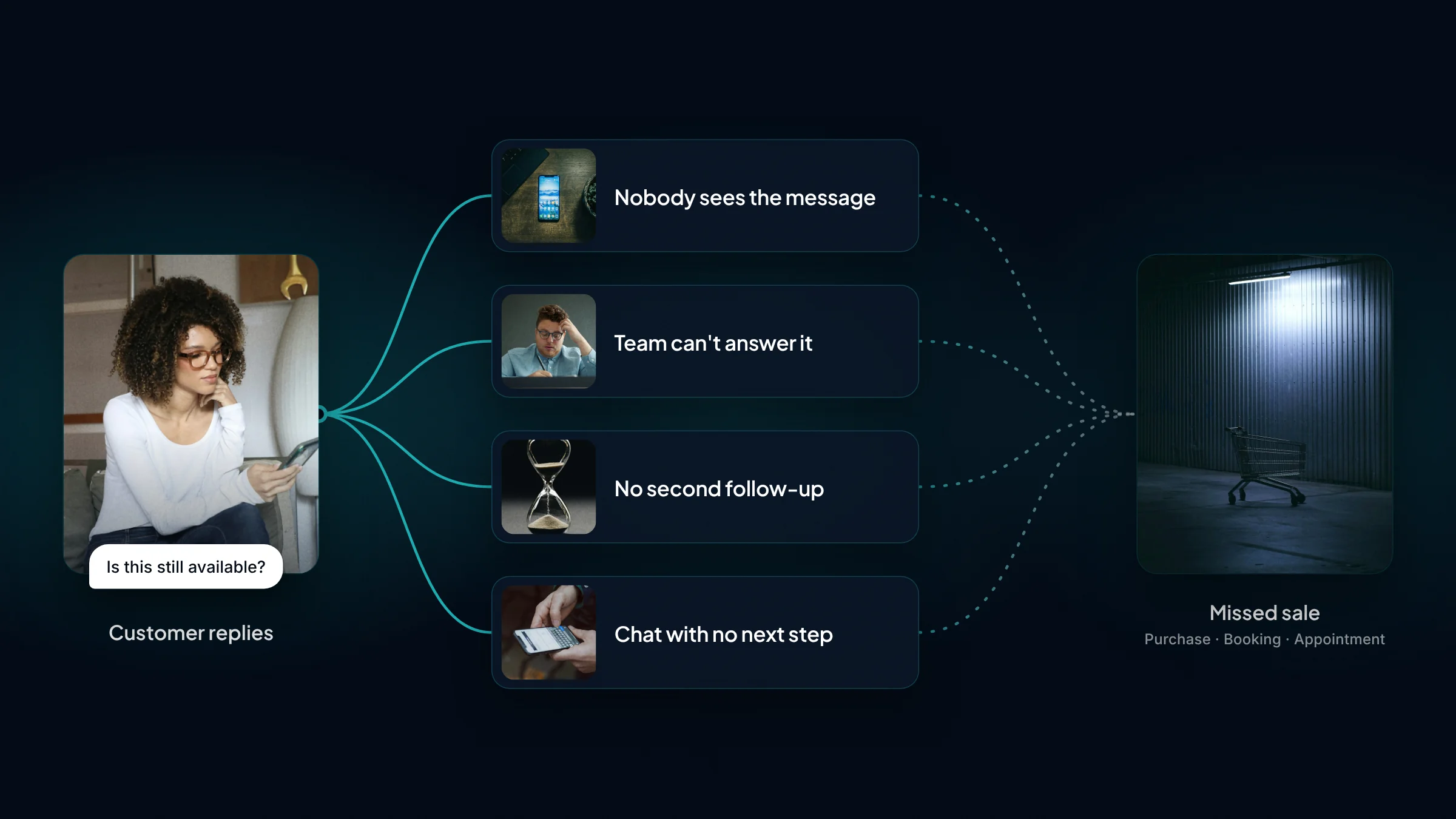
The problem is particularly relevant to companies that manage marketing and sales separately. The marketing team may be responsible for launching campaigns, while the sales team handles enquiries through another inbox or customer management system. When these activities are disconnected, promising conversations can become difficult to track.
Closing the gap requires a combination of timely responses, relevant messaging, clear ownership, customer context, and measurable follow up processes.
Why Customer Replies Matter More Than Businesses Realise
A customer who replies to a text is doing more than registering a passing interest. Depending on the message, that person may be expressing a specific need, requesting clarification, questioning a price, or showing readiness to make a decision.
According to EZ Texting's 2026 Consumer Texting Behavior Report, 89% of surveyed US consumers had signed up to receive texts from businesses. The report also found that 87% check a new text within 15 minutes. These findings indicate that text messaging has become an established communication channel for many consumers, although actual engagement varies by audience and message type.
The practical lesson is not that every customer will respond immediately or that every text will generate revenue. It is that businesses should treat incoming replies as valuable customer interactions rather than minor details in a campaign report.
Consider a customer who texts a furniture retailer to ask whether a sofa is available in a different colour. The question reveals a genuine product consideration. A useful response could confirm availability, share a product link, and explain delivery options.
If the customer receives a vague answer or no answer at all, that initial interest may disappear. If the retailer responds with accurate information and a relevant next step, the conversation can move closer to a purchase.
Recognising the SMS reply gap encourages businesses to examine these moments carefully. A reply is not the finish line. It is an opportunity to understand what the customer needs and help them make an informed decision.
Five Reasons Businesses Fail to Convert SMS Replies
1. Responses arrive too late
Timing can influence whether a customer continues a conversation. Someone comparing products may contact several businesses at once. If one company answers promptly with useful information while another takes an entire day, the faster business may earn the next step.
Delayed responses are not always caused by a lack of effort. Small teams may be handling phone calls, emails, appointments, and walk-in customers simultaneously. Incoming text messages can easily become buried among other responsibilities.
Businesses should establish clear response expectations, assign responsibility for incoming conversations, and use notifications or shared inboxes to reduce the risk of missed messages.
The objective is not to pressure employees into sending rushed answers. It is to ensure that customers receive timely, accurate information while their questions remain relevant.
2. Customer conversations become fragmented
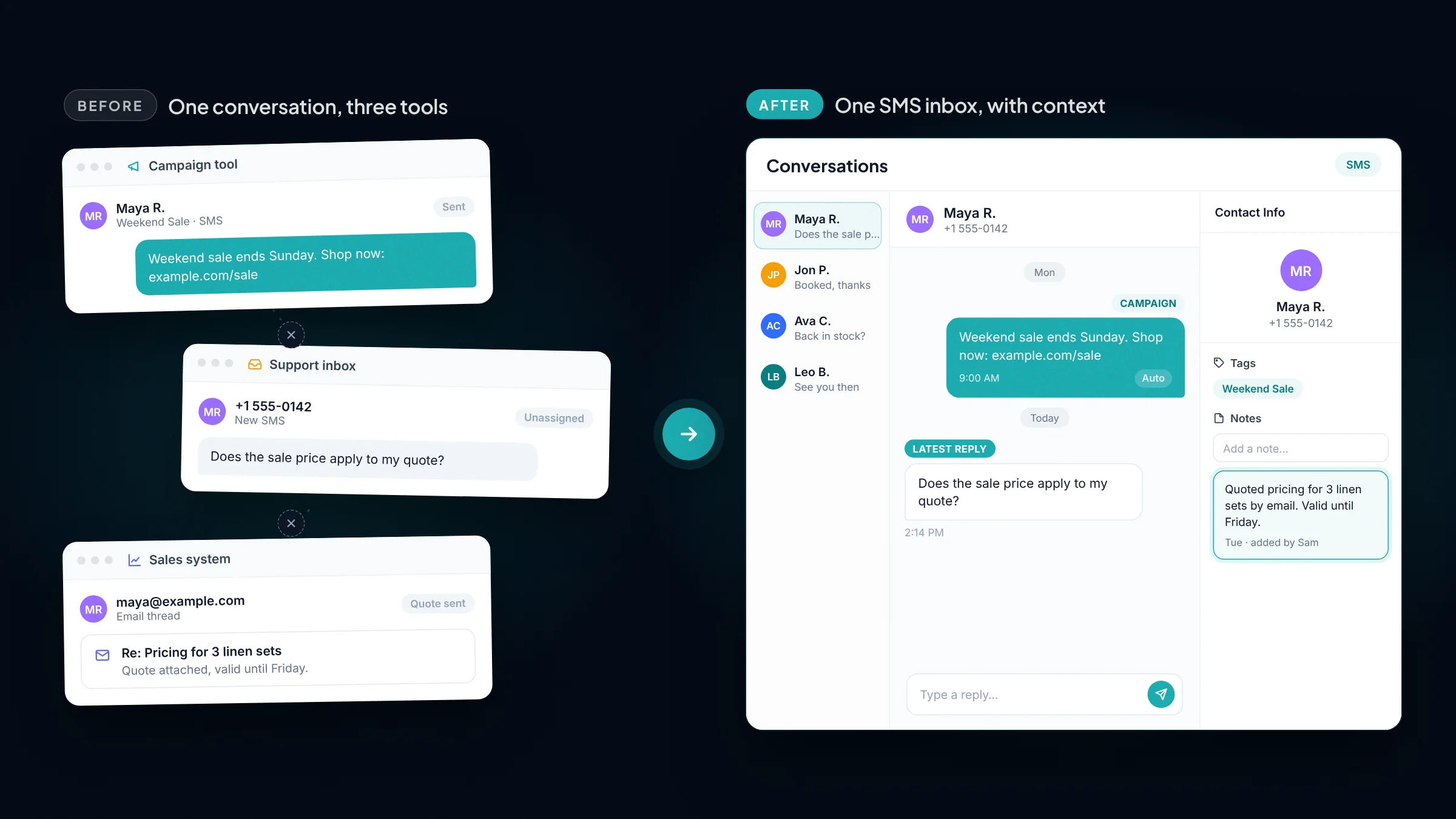
Some businesses use one platform for marketing campaigns, another for customer support and a third for sales enquiries. This arrangement can make it difficult to understand the complete customer journey.
An employee might see a customer's latest question without knowing which promotion the person received. Another team member may have already discussed pricing by email, but that information is unavailable in the messaging inbox.
This fragmentation creates repetitive questions and inconsistent answers. Customers may have to explain their requirements more than once, making the experience feel disorganised.
A shared SMS inbox can help centralise incoming text replies so that authorised team members can review conversations and coordinate responses. When the campaign message a customer received appears in the same thread as their reply, whoever answers can see which promotion prompted the question. Adding notes to the contact record can also capture context from other channels, such as pricing already discussed by email, so employees can respond with greater context.
3. Replies do not lead to a defined next step
A response can be friendly without being commercially useful. For example, a customer asks about a service package, and the business replies with a general description. The conversation ends without a booking link, consultation option, relevant question, or clear invitation to continue.
The solution is to identify the purpose of each conversation. A customer requesting a quote may need a short qualification process. Someone asking about an appointment may need available times. A shopper comparing products may benefit from a relevant recommendation.
Businesses should train their teams to answer the original question before suggesting an appropriate next step. This creates a natural progression without making the conversation feel like an aggressive sales pitch.
4. Every reply receives the same treatment
Not all customer responses have equal urgency or commercial significance. A request to unsubscribe requires immediate and appropriate handling. A product availability question may need a quick answer. A general comment may not require a sales conversation at all.
When every response enters the same unstructured queue, employees may spend too much time on low priority conversations while promising opportunities wait.
Segmentation and lead qualification can help distinguish between different types of replies. Businesses can organise conversations according to customer intent, requested service, purchase readiness, location, or other relevant criteria.
Automation may also classify incoming responses or suggest a suitable action, provided that the business reviews important decisions and handles sensitive situations appropriately.
5. Follow up is inconsistent
Some customers need additional information before making a decision. Others are interested but become distracted, need approval from another person, or want time to compare options.
A business that sends one response and then abandons the conversation may lose opportunities that could have progressed through a helpful follow up.
However, repeated messages without context can irritate customers. Effective follow up should refer to the original enquiry, provide additional value, and respect the customer's communication preferences.
For example, a fitness studio could answer a prospect's question about membership and later send the requested timetable. If the prospect does not book, the studio might offer a convenient trial session rather than repeating the same sales message.
How to Identify the SMS Reply Gap in Your Business
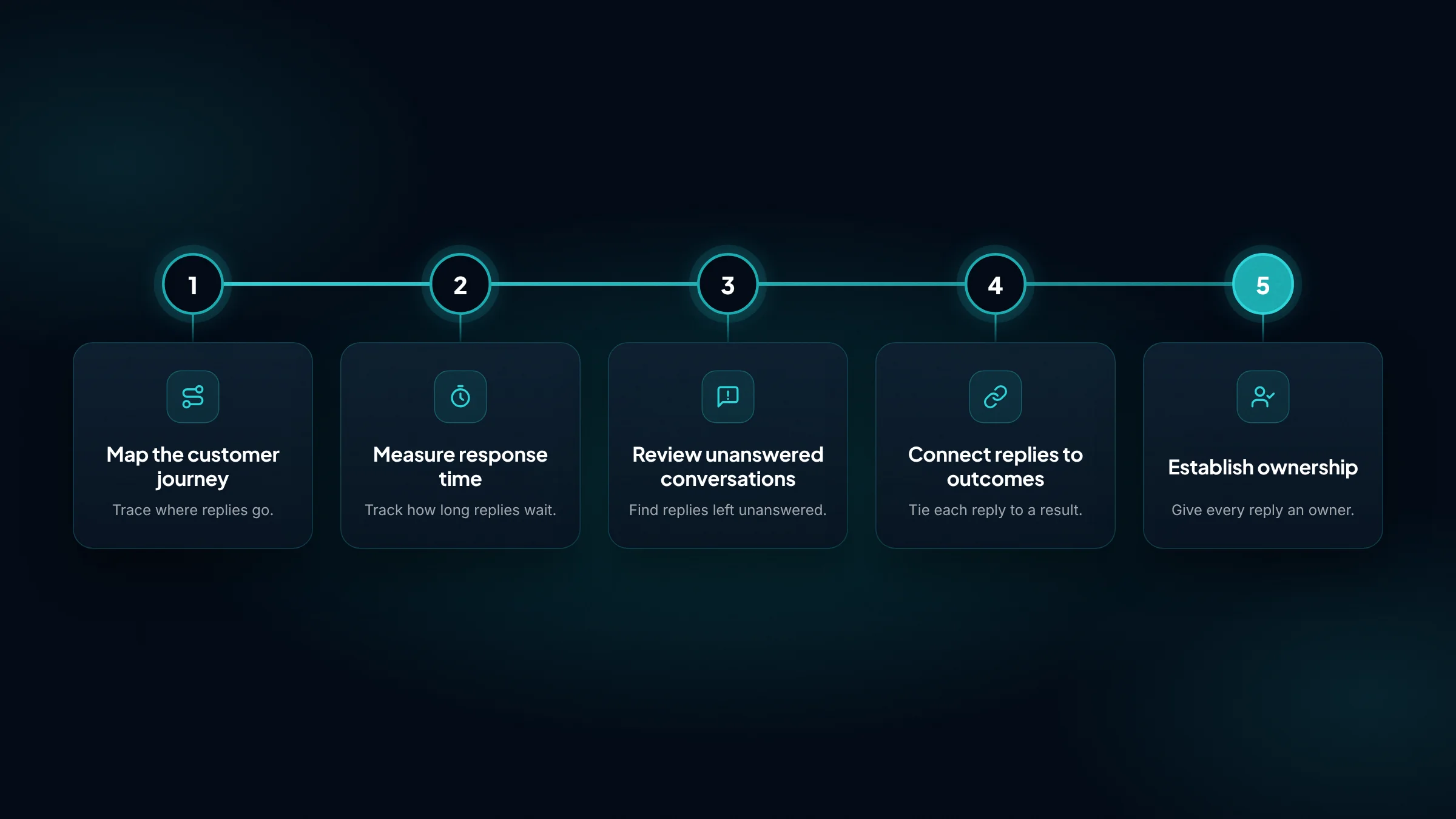
Before changing a marketing strategy, businesses should establish where conversations are breaking down. This requires examining the entire process from the first campaign to the final outcome.
Step 1: Map the customer journey
Start by documenting what happens after a customer receives a text. Identify where replies arrive, who monitors them, how conversations are assigned, and what happens when an employee is unavailable.
Include common scenarios such as product questions, appointment requests, quote enquiries, complaints, and requests to unsubscribe.
This exercise often reveals unclear responsibilities, disconnected tools, and unnecessary manual steps.
Step 2: Measure response time
Track the time between a customer sending a message and receiving the first meaningful response. A delivery confirmation or automatic acknowledgement should not be confused with an answer that resolves the customer's question.
Measure response times during business hours and outside business hours separately. Review averages alongside the percentage of conversations answered within the company's target.
For instance, a business might aim to answer routine enquiries within 30 minutes during staffed hours. That is an illustrative internal target, not a universal industry standard. The appropriate target depends on the industry, customer expectations, staffing, and urgency of the enquiry.
Step 3: Review unanswered conversations
Examine messages that have not received a response, conversations that ended without a next step, and enquiries that never progressed to a booking or purchase.
Look for recurring patterns. Are customers asking questions that employees cannot answer? Are leads assigned to the wrong department? Are replies arriving when the team is unavailable?
The purpose is to identify process failures rather than blame individual employees.
Step 4: Connect replies to outcomes
A high reply rate may indicate interest, but it does not show whether the campaign generated profitable business.
Connect messaging records with bookings, completed purchases, qualified leads, and revenue where practical. This makes it easier to distinguish between conversations that create genuine value and those that generate activity without meaningful results.
Step 5: Establish ownership
Every important conversation should have a clear owner or a defined queue with a responsible team. Businesses should also establish escalation procedures for complicated questions, complaints, payment problems, and other issues that require human judgement.
Practical Ways to Close the SMS Reply Gap
Use a shared inbox
A shared inbox allows authorised employees to manage incoming conversations from a central location. Instead of depending on one person's phone or a disconnected campaign dashboard, the team can review replies and coordinate responses.
Assigning conversations, adding internal notes, and maintaining a consistent view of customer interactions can make follow up more reliable.
Automate routine tasks
Automation is useful when the next action is predictable. A new enquiry could trigger an acknowledgement, a qualification question, or an assignment to the appropriate team.
A customer requesting an appointment reminder might enter a workflow that confirms the booking and sends relevant information before the visit.
Automation should not replace human judgement where customers need personalised advice, complex explanations, or sensitive support. Its purpose is to remove repetitive work and make the customer journey easier to manage.
Use AI assistance carefully
AI can help draft replies, summarise conversations, classify common questions, and recommend suitable next steps. This can be especially useful when a small team handles a large volume of enquiries.
However, AI generated responses should be checked for accuracy, tone, and relevance. Businesses should not allow a system to invent product details, promise unavailable services, or make sensitive decisions without suitable oversight.
The most effective approach combines the speed of automation with the judgement and empathy of a human team member.
Personalise the conversation
Personalisation involves more than inserting a first name. It means understanding the customer's question and providing information that helps them move forward.
A useful reply might refer to the product they asked about, the appointment they want to arrange, or the service area they mentioned. Businesses should use customer information responsibly and avoid collecting or exposing unnecessary personal data.
Build a sensible follow up sequence
A follow up sequence should have a clear purpose at every stage. The first message might answer a question. The next could provide requested information. A later message might offer a booking option or ask whether the customer still needs assistance.
Set appropriate intervals, stop promotional follow ups when a customer opts out, and avoid continuing a sales sequence after the issue has been resolved.
These practices make the process more helpful while reducing unnecessary communication.
The Metrics That Reveal Real Progress
Businesses should evaluate the quality of conversations as well as their volume. The following metrics provide a useful starting point.
| Metric | What it reveals |
|---|---|
| First meaningful response time | How quickly customers receive useful answers |
| Reply handling rate | The proportion of incoming replies that receive an appropriate response |
| Qualified lead rate | How many conversations reveal a genuine sales opportunity |
| Conversation to booking rate | How often enquiries become appointments or consultations |
| Conversation to purchase rate | How often customer conversations lead to completed purchases |
| Follow up completion rate | Whether planned follow ups are carried out |
| Opt out rate | Whether messaging frequency or relevance may need improvement |
| Revenue per campaign | The commercial value associated with a campaign |
Establish a baseline before introducing changes. Then compare performance across similar periods and campaign types. Account for differences in audience size, offers, seasonality, and customer intent.
A company should also avoid treating every attributed purchase as incremental revenue. Some customers would have purchased without receiving the message. Comparing suitable test groups can help estimate the actual effect of a campaign.
An Example of a Better SMS Response Process
Consider a property agency that sends text messages to people who have requested information about available homes.
A prospect replies asking whether a property is still available and whether viewings are possible on Saturday. Without a defined process, the message might remain unanswered until the next working day.
A better process begins by routing the enquiry to the appropriate agent. The agent checks availability, answers the question, and shares the next step for arranging a viewing. If the prospect confirms interest, the conversation is marked for follow up. If the property is no longer available, the agent can ask whether similar listings would be useful.
The agency then tracks whether the enquiry resulted in a viewing and whether the viewing progressed further.
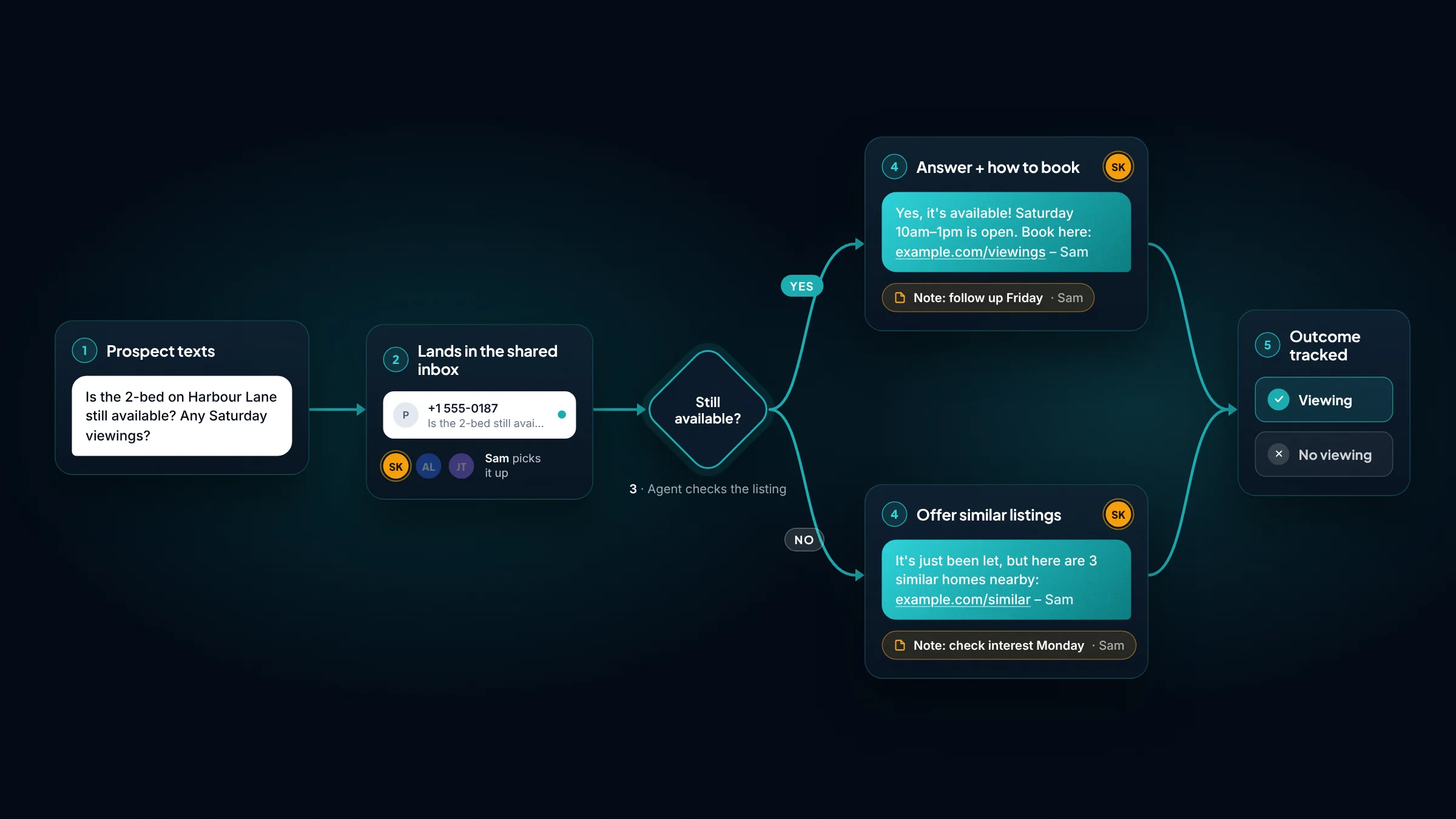
This example illustrates how the SMS reply gap can be reduced through clear ownership, relevant responses, and measurable next steps. The improvement does not depend on sending more promotional messages. It comes from managing existing interests more effectively.
Common Mistakes to Avoid
Businesses attempting to improve SMS conversions should avoid several common mistakes.
- Sending more messages before fixing unanswered enquiries.
- Using generic automated replies that fail to address the customer's actual question.
- Measuring success through reply volume alone.
- Following up repeatedly without considering customer intent or preferences.
- Allowing AI to send unverified information or make promises the business cannot fulfil.
- Ignoring consent requirements, opt out requests, applicable messaging laws, and platform rules.
- Treating every conversation as a sales opportunity, even when a customer needs support or simply wants to end communications.
These mistakes can increase operational complexity without improving customer experience.
How Messaro Helps Businesses Turn Replies Into Opportunities
Closing the SMS reply gap requires more than a campaign tool. Businesses need a practical way to send relevant messages, manage incoming responses, automate routine actions, and understand what happens next.
At Messaro, we bring SMS marketing, email marketing, automation, analytics, and AI assistance together in one platform. Incoming texts are handled as SMS conversations. Email has its own two-way conversations, and an email reply does not land in the same inbox as a text. AI drafted responses can support faster and more consistent replies, and a person still reviews them before they are sent.
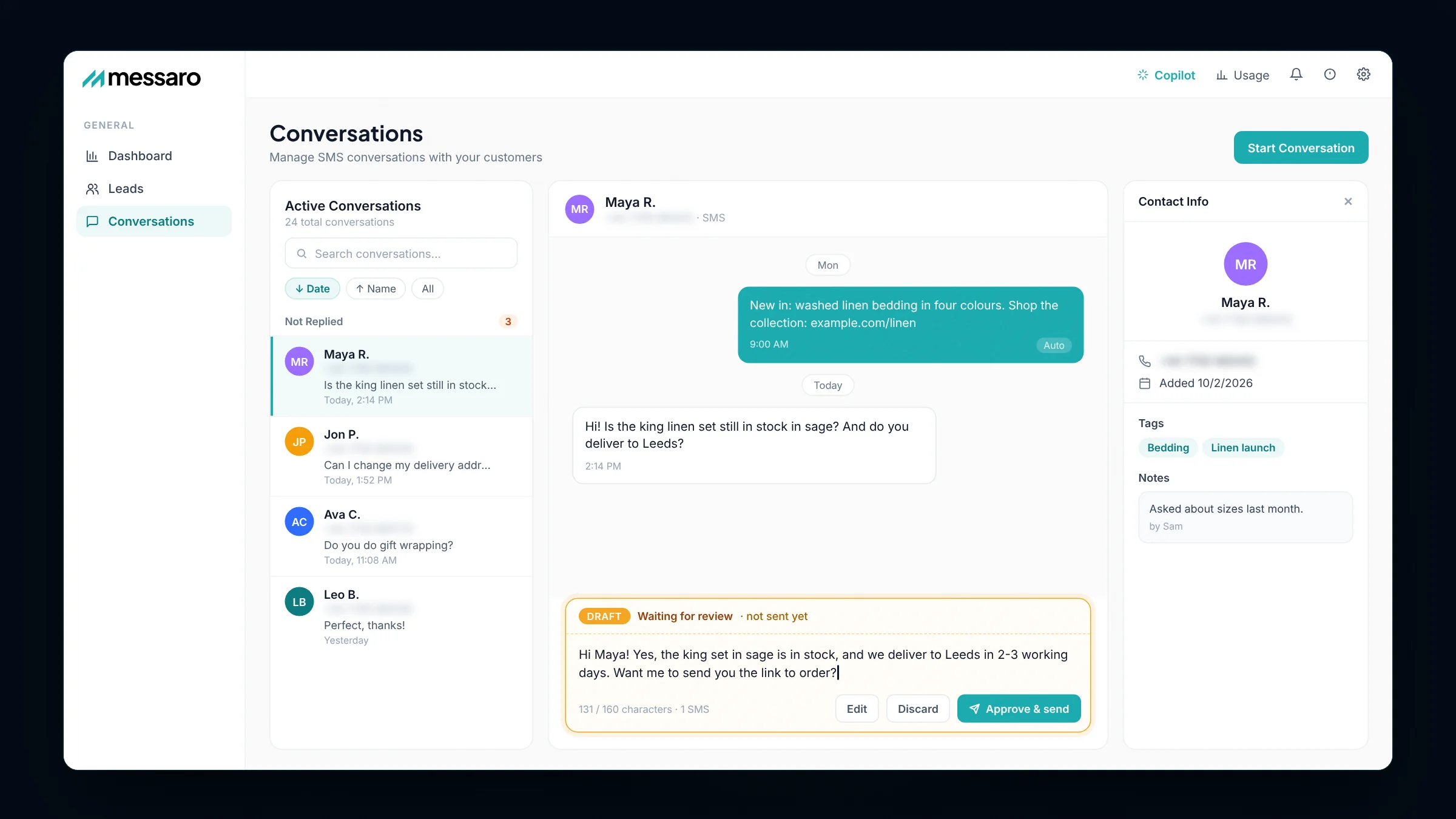
Our automation tools can help businesses create lead qualification workflows, organise follow ups, and direct conversations towards appropriate next steps. With campaign analytics, businesses can review responses, clicks, and other performance indicators to understand how their marketing is working.
We also provide an AI Copilot that can help users prepare campaigns, create automation workflows, and organise customer segments. Businesses can use these capabilities to reduce repetitive tasks while retaining control over the messages they send.
Whether you operate an online store, a property agency, a fitness business, or a growing service company, our goal is to make customer communication easier to manage and more useful to the people receiving it.
With Messaro, you can begin building a more organised approach to SMS and email marketing without needing a complicated collection of separate tools. Explore our platform and discover how our messaging and automation features can support your next stage of growth.
Frequently Asked Questions
What does the SMS reply gap mean?
The SMS reply gap is the distance between a customer responding to a business text and the business taking an appropriate action that advances the conversation. It can involve delayed responses, missed messages, poor follow up, or a lack of clear next steps.
How quickly should a business respond to an SMS enquiry?
Response time depends on the industry, customer expectations, and the nature of the enquiry. Businesses should establish realistic service targets, monitor meaningful response times, and prioritise urgent or commercially important conversations.
Can automation help businesses convert more SMS replies?
Yes. Automation can route enquiries, acknowledge incoming messages, ask qualification questions, and schedule appropriate follow ups. Human oversight remains important for complex questions, sensitive situations, and decisions that require judgement.
How can businesses measure SMS reply performance?
Businesses can track meaningful response time, reply handling rate, qualified leads, bookings, purchases, opt outs, and revenue associated with campaigns. These metrics provide a more complete picture than message delivery or reply volume alone.