
 Sebastian Stokkendal
In This Article▼
The holiday season is one of the biggest revenue opportunities for businesses. From Black Friday and Cyber Monday to Christmas, Hanukkah, New Year's Eve, and other seasonal celebrations, consumers become more active, explore new products, compare prices, and look for special offers. For businesses, this creates an opportunity to attract new customers, reconnect with existing subscribers, and generate more sales through well-planned email campaigns.
However, holiday marketing in 2026 requires more than sending promotional emails with festive designs and discount codes. Consumers receive hundreds of marketing messages during the holiday season. Generic promotions, repetitive subject lines, and poorly timed emails can easily get ignored. Businesses need to understand customer behaviour, deliver relevant content, and create personalised experiences that encourage people to take action.
This is where effective holiday email marketing campaign strategies become important. A well-organised campaign can help businesses stay connected with their audiences throughout the holiday shopping journey, from early-season awareness to last-minute purchases and post-holiday engagement.
Email marketing also offers businesses greater control over their customer relationships. Unlike social media campaigns, where visibility depends heavily on platform algorithms, email allows brands to communicate directly with subscribers who have already expressed an interest in their products or services.
In this article, we explore 12 practical holiday email marketing campaign strategies that businesses can implement in 2026. Each strategy includes examples, implementation tips, and ideas for making holiday communications more engaging and profitable.
Why Holiday Email Marketing Matters in 2026
Holiday shopping behaviour continues to evolve. Customers increasingly expect relevant recommendations, convenient purchasing experiences, transparent delivery information, and timely offers. They also interact with businesses across multiple channels, including email, SMS, websites, and social media.
Email remains particularly valuable because it supports the entire customer journey. Businesses can use it to introduce seasonal collections, announce exclusive discounts, recover abandoned shopping carts, share gift recommendations, and encourage repeat purchases.
Here are several reasons businesses should prioritise email during the 2026 holiday season:
- Direct customer communication. Businesses can reach subscribers without depending entirely on social media algorithms.
- Personalised shopping experiences. Customer preferences and purchase histories can inform relevant product recommendations.
- Cost-effective promotions. Email allows businesses to communicate with large audiences without paying for every individual impression.
- Automated customer journeys. Welcome emails, abandoned-cart reminders, and post-purchase messages can run automatically.
- Measurable performance. Open rates, clicks, conversions, revenue, and unsubscribe rates help marketers evaluate campaign effectiveness.
The key is to approach holiday email marketing as a complete customer engagement strategy rather than a collection of unrelated promotional messages.
12 Holiday Email Marketing Campaign Strategies for 2026
1. Start Holiday Promotions Earlier to Capture Early-Bird Shoppers
One of the biggest mistakes businesses make is waiting until Black Friday or December to launch their holiday email campaigns. Modern consumers increasingly start researching and purchasing holiday gifts before the traditional shopping rush. Reaching these shoppers early gives businesses more opportunities to influence their decisions.
According to a Gartner survey published in October 2026, 57% of US consumers planned to begin winter holiday shopping in October or earlier. The research also found that nearly 60% expected to have less money available for holiday purchases than the previous year. This suggests that customers are planning earlier and paying closer attention to their spending.
Businesses should therefore build a promotional calendar that starts well before major shopping events.
How to implement this strategy:
- Start sending holiday previews in October.
- Introduce upcoming discounts and seasonal product collections.
- Offer early access to subscribers before public promotions begin.
- Send gift guides to customers who are still researching their options.
- Use countdown emails to create anticipation for upcoming sales.
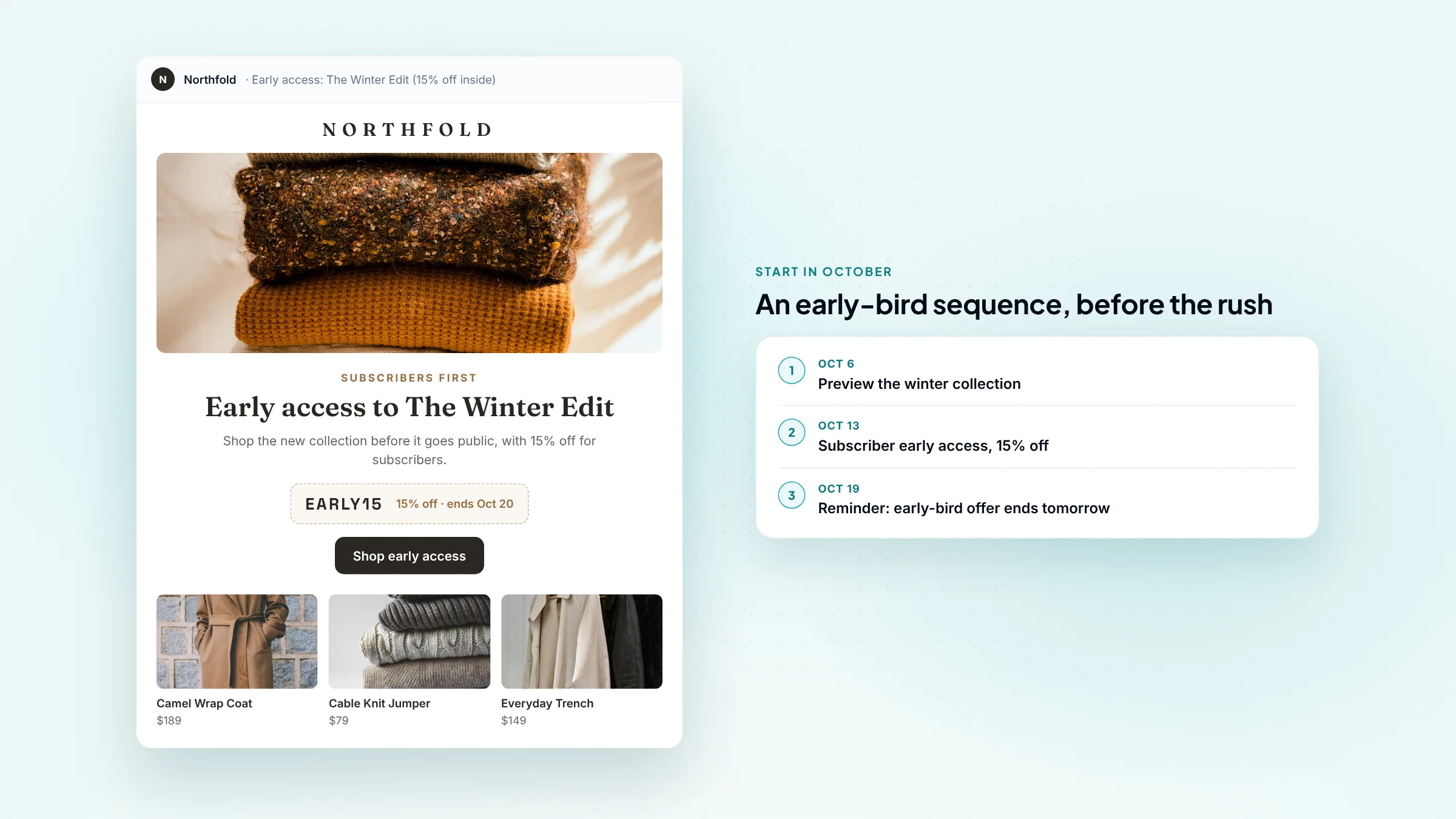
Example: An online clothing store can send an early-access email in October showcasing its winter collection. A second email can introduce a 15% early-bird discount, while a third can remind subscribers when the promotion ends.
“The brands that win the holiday season are often the ones that start building customer relationships before everyone else starts discounting. Early communication gives businesses time to understand what their customers actually want.”
- Sebastian Stokkendal, Owner & CEO of Messaro
2. Segment Your Email List for More Relevant Promotions
Sending the same holiday promotion to every subscriber may seem convenient, but it rarely delivers the most relevant customer experience. Different customers have different interests, budgets, shopping habits, and purchasing histories.
For example, someone who regularly purchases premium skincare products may respond better to an exclusive skincare collection than a generic discount on every product. Similarly, a first-time subscriber might need an introductory offer before considering a purchase.
Audience segmentation allows businesses to divide their subscriber lists into smaller groups and create campaigns that address their individual needs.
How to implement this strategy:
Consider creating the following customer segments:
- New subscribers. People who recently joined your email list and may need introductory offers.
- Repeat customers. Existing buyers who can receive loyalty rewards and early access.
- Inactive subscribers. People who have not opened or clicked recent campaigns.
- High-value customers. Customers with higher purchase frequency or average order values.
- Product-specific audiences. Subscribers interested in particular product categories.
- Location-based audiences. Customers who may receive different offers based on regional holidays, delivery availability, or weather conditions.
Example: A beauty retailer can send premium gift sets to high-value customers, affordable stocking fillers to budget-conscious shoppers, and a special welcome discount to new subscribers.
The important thing is to use customer information responsibly. Businesses should collect only the data they need, respect marketing consent, and avoid making assumptions based on sensitive personal information.
3. Create Personalised Holiday Email Recommendations
Personalisation goes beyond including someone's first name in the subject line. In 2026, customers increasingly expect brands to understand their preferences and make shopping easier.
A personalised holiday email can include recommended products, relevant discounts, recently viewed items, complementary products, and content based on previous interactions.
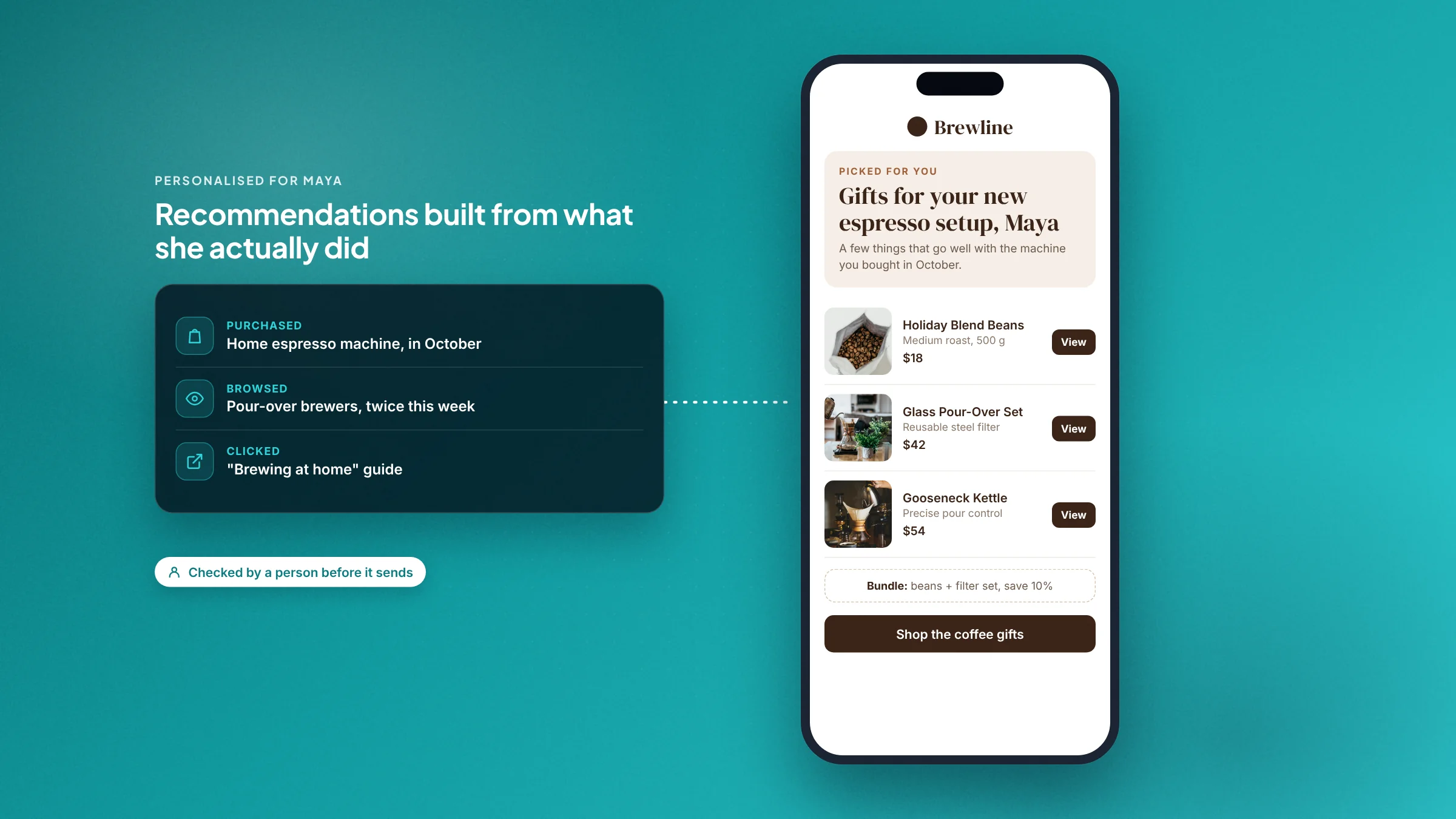
For instance, if a customer recently purchased a coffee machine, a holiday email featuring coffee beans, reusable filters, and accessories may be more relevant than a generic electronics promotion.
How to implement this strategy:
- Review customers' previous purchases and browsing behaviour.
- Identify product categories that attract individual subscribers.
- Recommend complementary products based on their interests.
- Include personalised product images and descriptions.
- Create different recommendations for new and returning customers.
- Regularly update recommendations as customer behaviour changes.
Businesses can also use AI-powered tools to analyse customer preferences and generate product recommendations. However, human review remains important to ensure recommendations are accurate and appropriate.
Example: An online bookstore can send a personalized Christmas email featuring recently released books from genres a subscriber frequently explores. The email can also include a bundle offer for customers interested in purchasing multiple titles.
“Personalisation should make shopping easier, not simply make an email look more customised. When businesses understand customer interests, every recommendation has a better chance of being meaningful.”
- Sebastian Stokkendal, Owner & CEO of Messaro
4. Design Festive Emails That Reflect Your Brand Identity
Visual presentation plays an important role in holiday email marketing. A well-designed email can capture attention, communicate an offer, and encourage subscribers to explore a product or service.
However, adding Christmas trees, snowflakes, red backgrounds, and decorative fonts to every email is not necessarily an effective design strategy. Businesses should create festive campaigns while maintaining their existing brand identity.
A consistent visual identity helps customers recognise a business even when its regular marketing materials are replaced with seasonal designs.
How to implement this strategy:
- Use seasonal colours that complement your existing brand palette.
- Include high-quality product photographs.
- Create attractive holiday banners and promotional graphics.
- Use clear headings and short, readable paragraphs.
- Highlight discounts without overwhelming the design.
- Add prominent call-to-action buttons.
- Maintain consistent typography and brand elements.
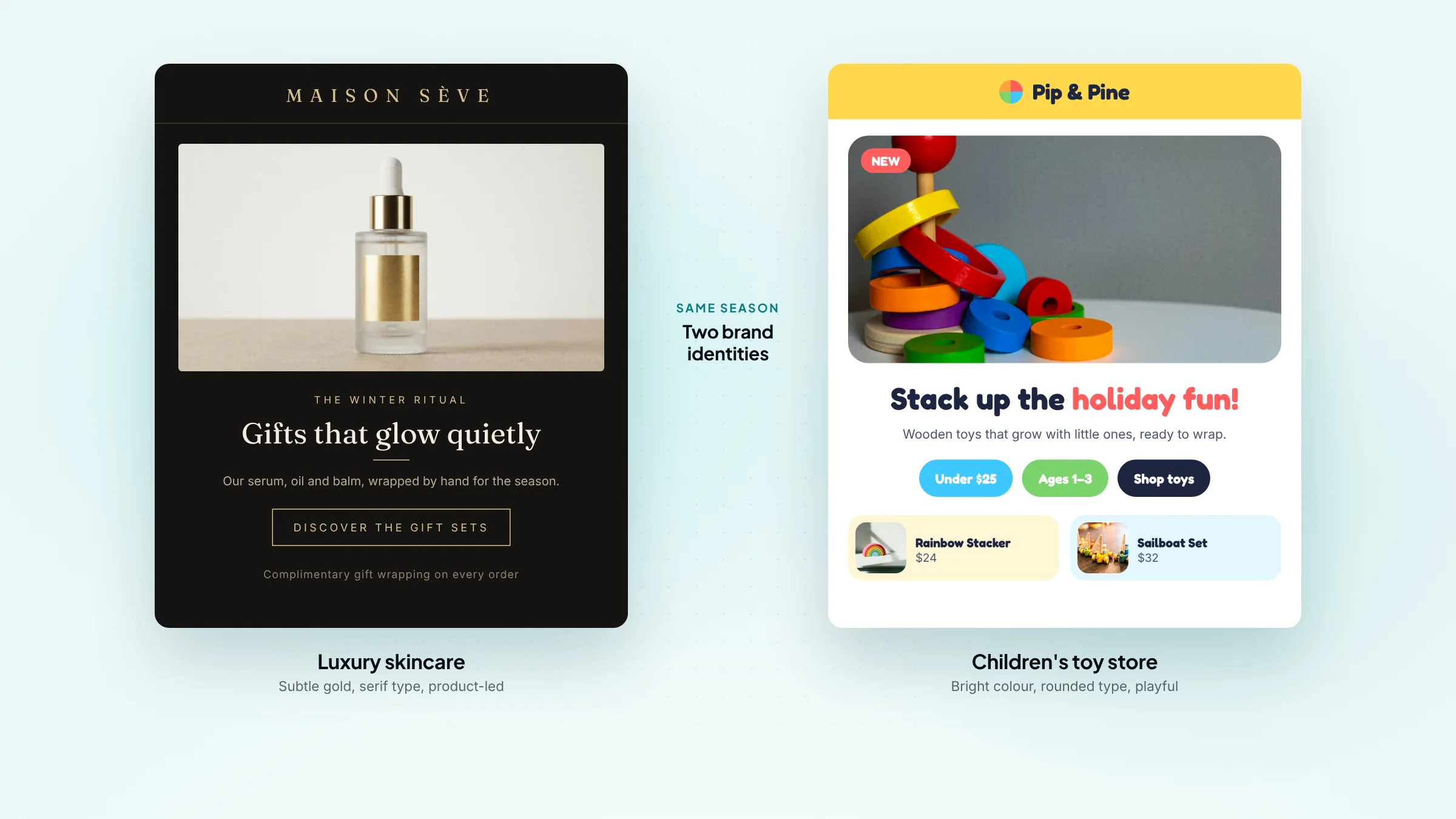
For example, a luxury skincare brand might use subtle gold accents, elegant typography, and premium product photography instead of traditional Christmas illustrations. A children's toy store, on the other hand, could use colourful graphics and playful festive elements.
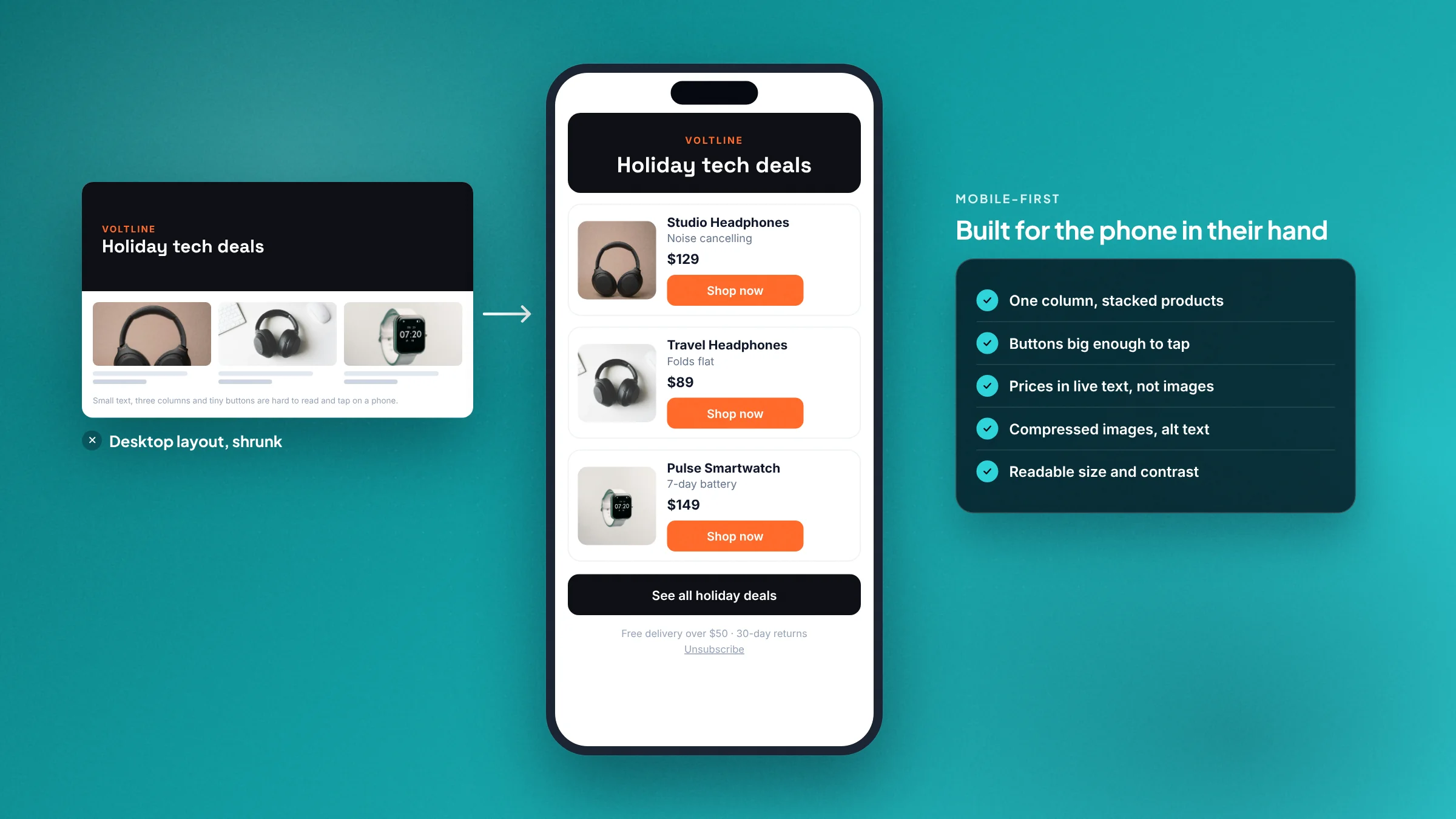
Mobile responsiveness is equally important. Emails should display correctly on smartphones, with readable text, appropriately sized images, and buttons that are easy to tap.
5. Build Excitement Through Countdown and Limited-Time Offers
Urgency can encourage customers to make purchasing decisions, particularly during major holiday shopping events. Countdown campaigns and limited-time promotions communicate that an offer is available for a specific period.
However, urgency should be genuine. Businesses should not repeatedly claim that an offer expires in a few hours when the same discount continues throughout the week. Misleading countdowns can damage customer trust.
How to implement this strategy:
- Announce when a holiday promotion begins.
- Send a reminder before the offer expires.
- Highlight limited-stock products when inventory information supports the claim.
- Use countdown timers for genuine deadlines.
- Create separate campaigns for Black Friday, Cyber Monday, and Christmas.
- Communicate the exact promotion end date and time.
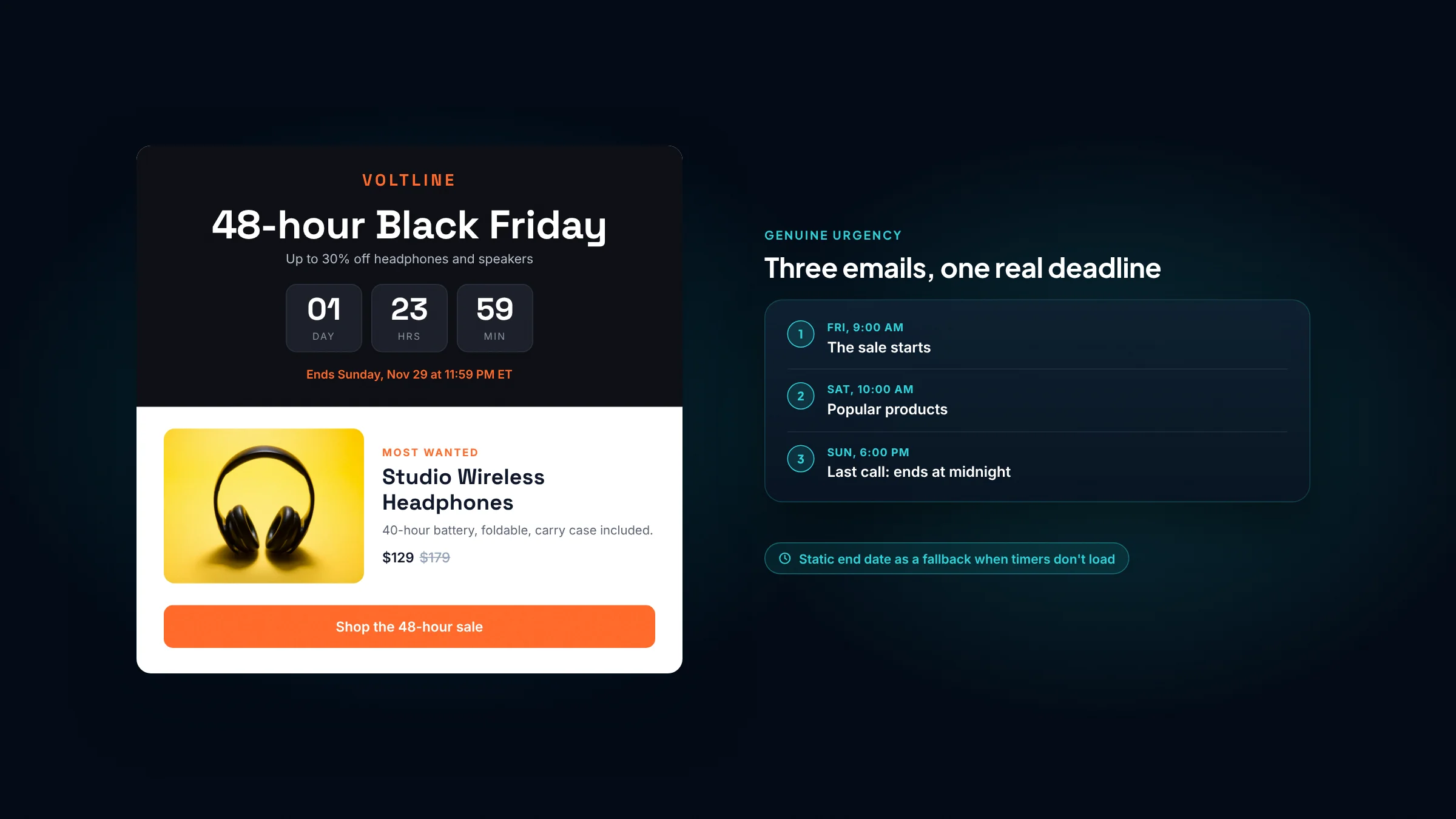
Example: An electronics retailer can announce a 48-hour holiday sale with a dedicated email. The first message introduces the offer, the second highlights popular products, and the final reminder informs subscribers that the discount ends at midnight.
A countdown timer can make the deadline more visible, but businesses should ensure that the timer works correctly across different email clients. A static deadline is a useful fallback when interactive elements are unsupported.
6. Combine Email and SMS Marketing for Better Customer Engagement
Customers do not interact with businesses through a single communication channel. They may discover a product through an email, visit a website, receive an SMS reminder, and eventually complete their purchase through a mobile device.
Combining email and SMS allows businesses to communicate with customers through complementary channels.
Email is particularly useful for detailed product information, seasonal collections, newsletters, gift guides, and promotional storytelling. SMS works well for short, time-sensitive updates, such as flash sales, order notifications, and delivery reminders.
Mailchimp's analysis of more than 44 billion emails and 83 million text messages during the 2025 peak shopping season found that SMS order rates were higher than email order rates in its dataset. SMS also generated higher revenue per message, while email generated more total revenue because businesses sent considerably more email messages. These findings demonstrate why the channels should complement rather than replace each other.
How to implement this strategy:
- Send detailed holiday offers through email.
- Use SMS for important promotional reminders.
- Notify customers about genuine flash sales through text messages.
- Send order confirmations and delivery updates through the appropriate channel.
- Avoid sending identical messages through email and SMS simultaneously.
- Respect separate consent requirements for each communication channel.
Example: A fashion retailer can send an email introducing its Christmas collection on Monday. On Wednesday, it can send an SMS to customers who have separately opted into text marketing, reminding them about an exclusive offer.
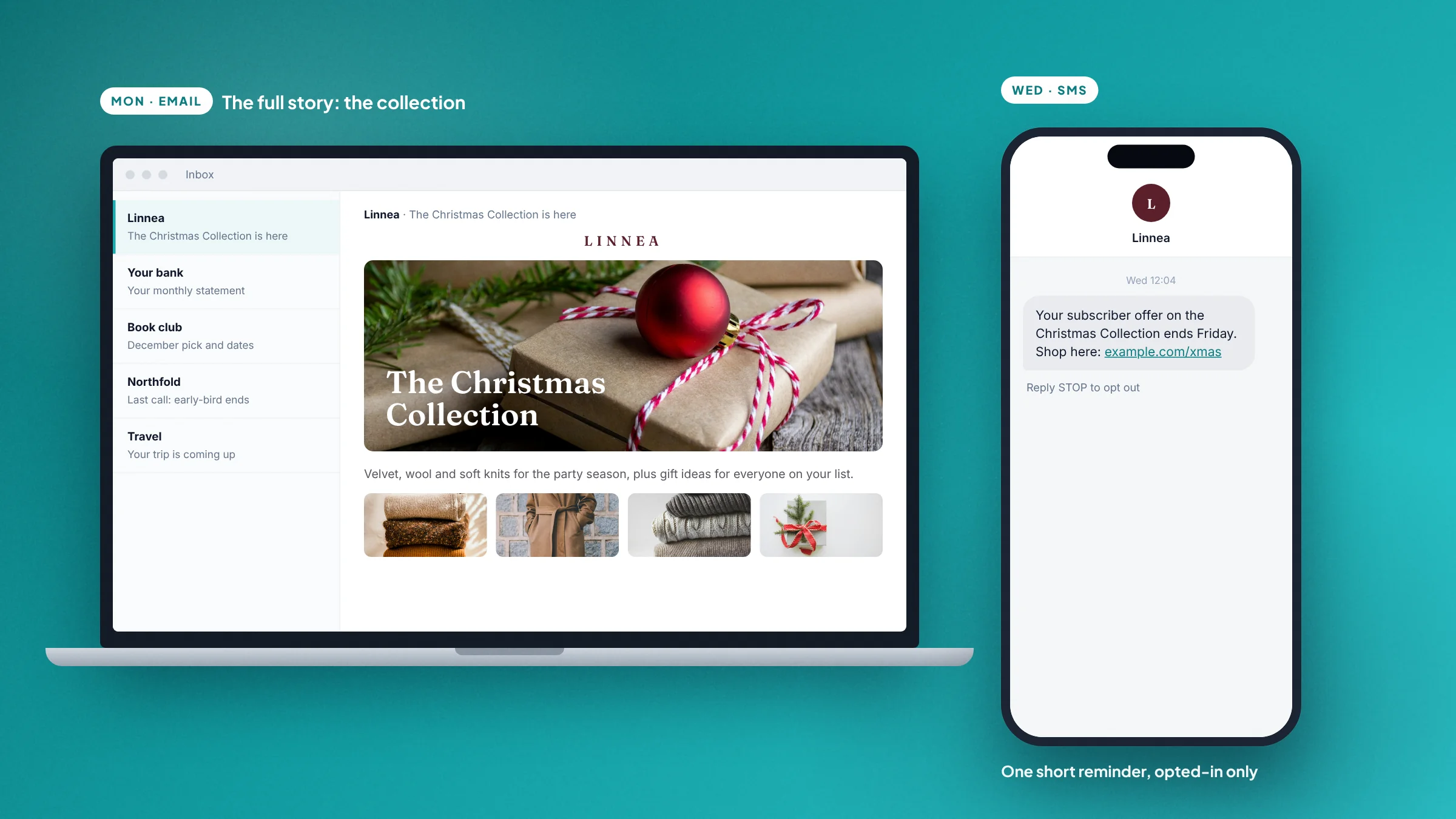
“Email and SMS work best when each channel has a clear purpose. Businesses should use email to tell the complete story and SMS to deliver timely messages that customers genuinely need.”
- Sebastian Stokkendal, Owner & CEO of Messaro
7. Recover Abandoned Shopping Carts with Automated Emails
Abandoned shopping carts represent a significant opportunity for online businesses during the holiday season. Customers frequently add products to their carts but leave websites without completing their purchases. This can happen because they are comparing prices, waiting for payday, checking delivery dates, or simply getting distracted.
An automated abandoned-cart email can remind customers about the products they left behind and encourage them to return to complete their orders.
This is one of the most useful holiday email marketing campaign strategies because it allows businesses to follow up with interested shoppers without manually sending individual messages.
How to implement this strategy:
- Send the first reminder within a few hours of cart abandonment.
- Include images and names of the abandoned products.
- Provide a direct link to the customer's shopping cart.
- Highlight relevant product benefits and customer reviews.
- Consider offering a small discount in a later reminder.
- Include clear information about shipping and return policies.
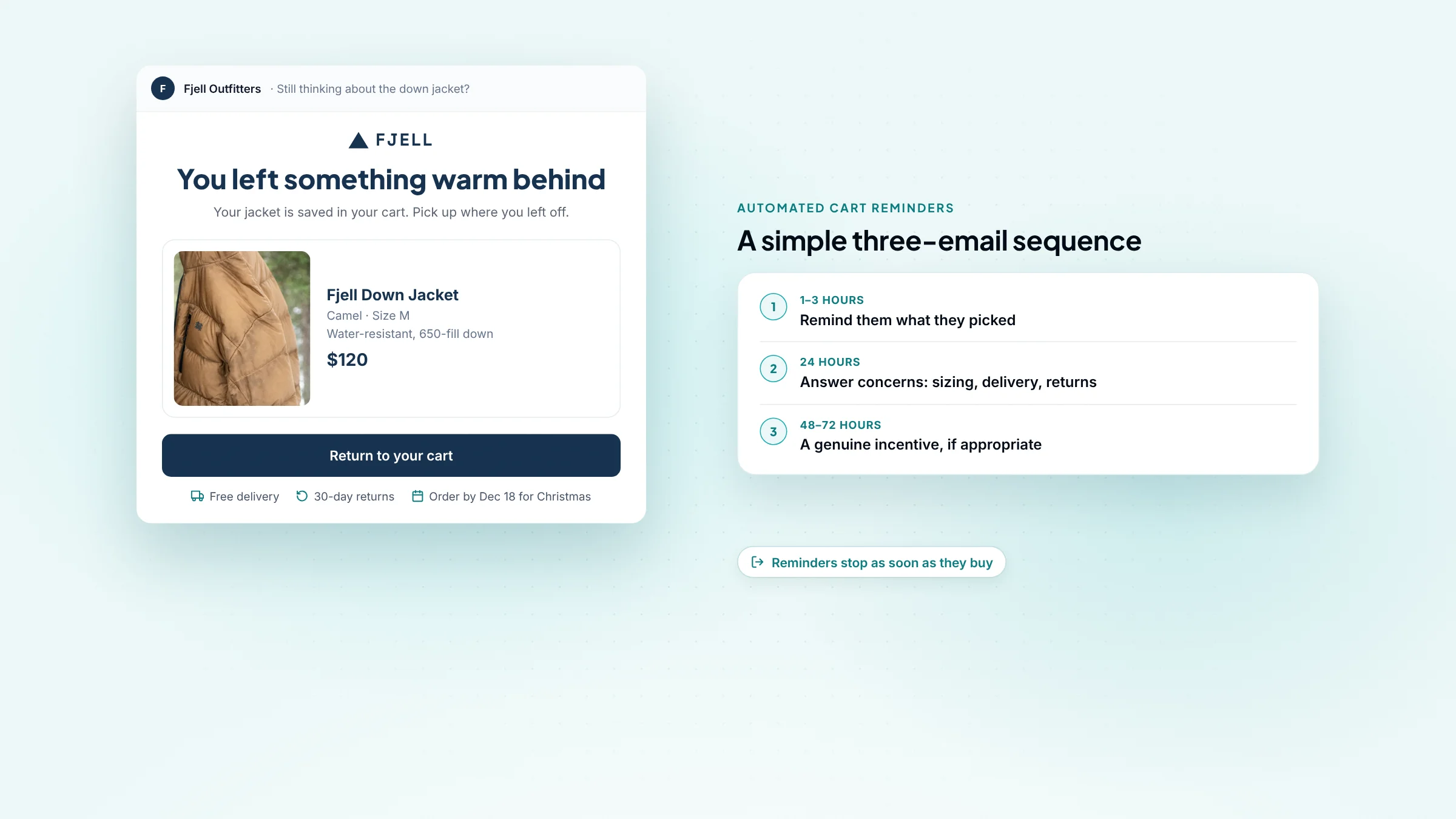
A simple three-email abandoned-cart sequence could look like this:
| Timing | Purpose | |
|---|---|---|
| First reminder | 1–3 hours | Remind customers about their selected products |
| Second reminder | 24 hours | Address common purchasing concerns |
| Final reminder | 48–72 hours | Offer a genuine incentive, if appropriate |
Example: A customer adds a winter jacket worth $120 to their shopping cart but leaves without purchasing it. The retailer can send an automated email displaying the jacket, its available sizes, and a direct checkout link. A follow-up email can highlight free shipping or an upcoming delivery deadline.
Businesses should ensure that cart reminders comply with applicable privacy and electronic marketing requirements. They should also stop promotional reminders when a purchase is completed.
8. Create Holiday Gift Guides and Product Roundups
During the holiday season, many customers know they want to purchase gifts but struggle to decide what to buy. They may be shopping for family members, friends, colleagues, or people with very different interests.
Gift guides solve this problem by organising product recommendations into convenient categories. Instead of expecting customers to browse an entire website, businesses can help them discover relevant products through carefully curated email content.
Gift guides are also useful for introducing products that customers might not have discovered otherwise.
How to implement this strategy:
Create different gift guides based on:
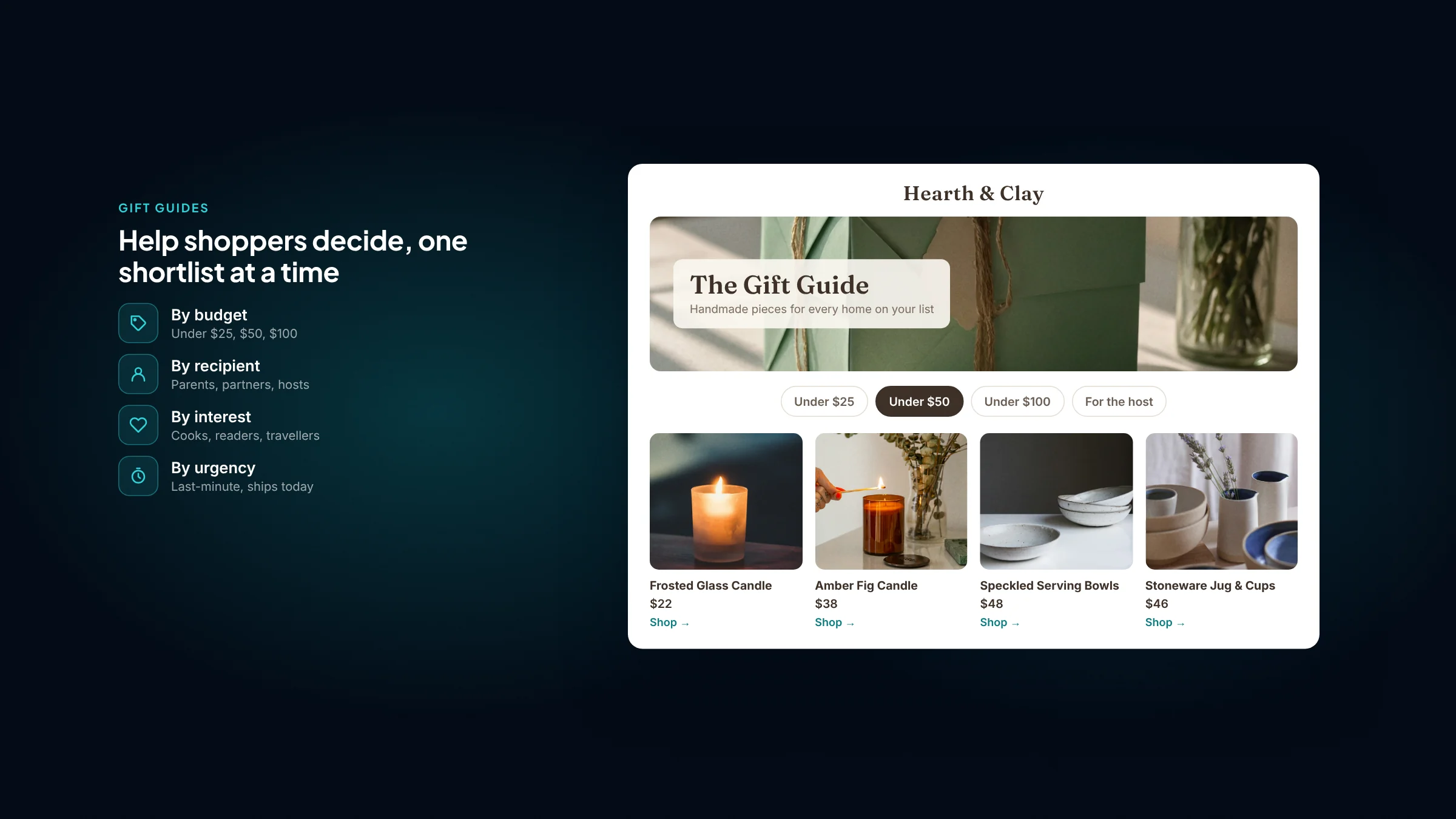
- Budget: Gifts under $25, $50, or $100.
- Recipient: Gifts for parents, partners, children, and colleagues.
- Interests: Gifts for travellers, fitness enthusiasts, readers, and technology lovers.
- Product categories: Beauty products, clothing, electronics, home accessories, and food hampers.
- Shopping urgency: Last-minute gifts and products available for immediate delivery.
Example: An online home décor business can send a Christmas gift guide featuring decorative candles, tableware, scented diffusers, and festive cushions. Each recommendation can include a product image, price, short description, and direct shopping link.
Another effective approach is to create a gift guide for different budgets. Customers who want affordable gifts can explore lower-priced products, while those shopping for premium presents can discover higher-value collections.
These campaigns should be visually organised and easy to navigate. Avoid including too many products in one email, as an overcrowded layout can make decision-making more difficult.
9. Use A/B Testing to Improve Holiday Email Performance
Even well-designed emails do not always perform as expected. A subject line that works for one audience may receive little attention from another. Similarly, a promotional offer that generates clicks may not necessarily produce purchases.
A/B testing allows marketers to compare different versions of an email and identify which elements perform better.
Rather than relying entirely on assumptions, businesses can use campaign data to make informed decisions.
How to implement this strategy:
Test one major element at a time, including:
- Subject lines: Compare promotional wording with curiosity-driven messaging.
- Preview text: Test different introductory messages.
- Email designs: Compare image-heavy layouts with simpler designs.
- Call-to-action buttons: Test wording such as “Shop Now” against “Explore the Collection”.
- Offers: Compare free shipping with percentage-based discounts.
- Send times: Test different delivery times for comparable audience groups.
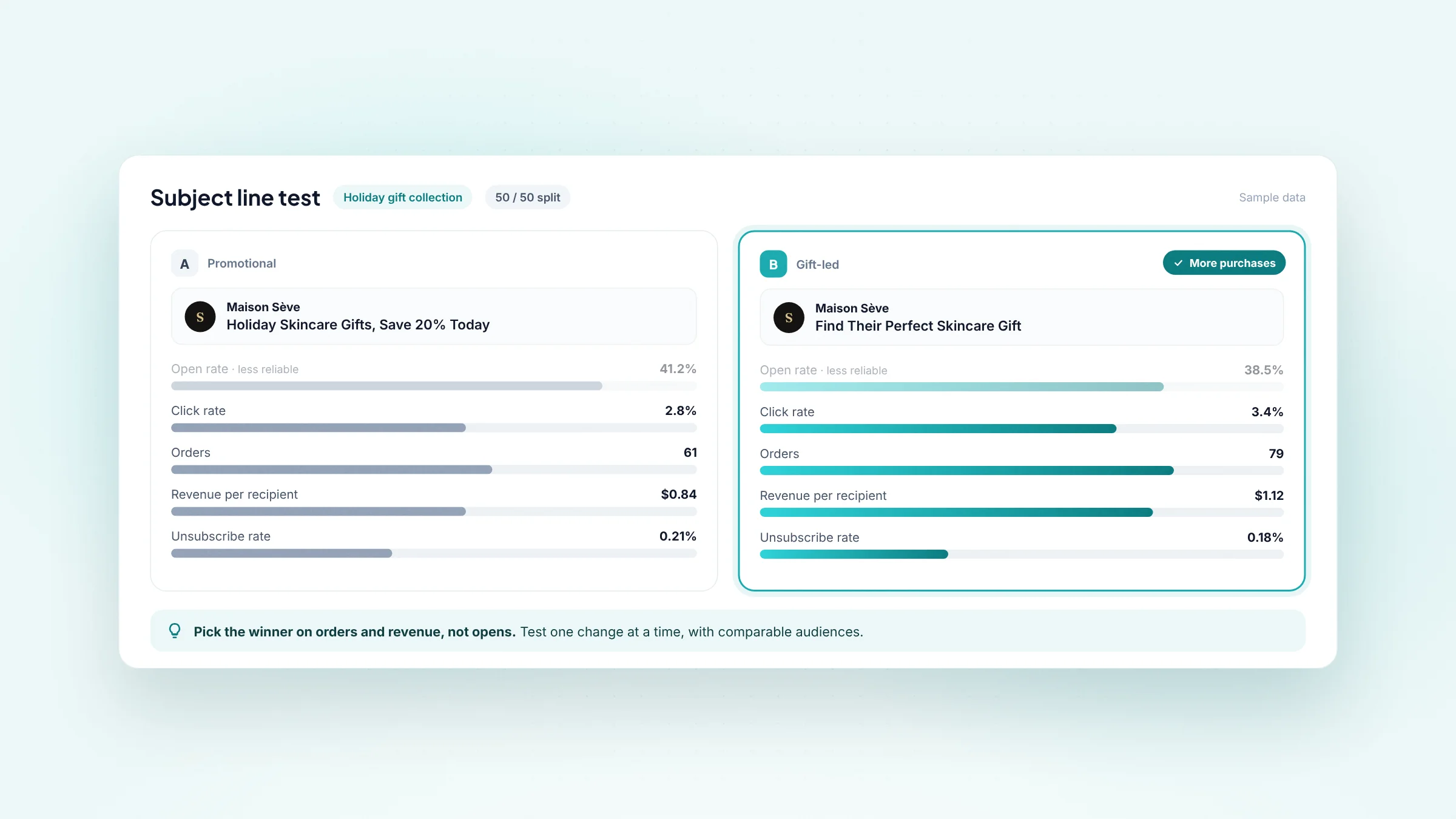
Example: A skincare retailer wants to promote its holiday gift collection. It can test two subject lines:
- Version A: “Holiday Skincare Gifts, Save 20% Today”
- Version B: “Find Their Perfect Skincare Gift”
The business can compare clicks and purchases to understand which approach attracts more valuable engagement.
When conducting A/B tests, use comparable audience groups and a sufficiently large sample. Avoid changing several elements simultaneously because it becomes difficult to identify what influenced the result.
It is also important to measure more than email opens. Privacy features and automated email activity can make open rates less reliable. Clicks, conversions, revenue per recipient, and unsubscribe rates provide additional context.
10. Optimise Emails for Mobile Devices
Mobile-friendly design is no longer an optional feature. Customers frequently discover promotions, read newsletters, and purchase products using smartphones. An email that looks attractive on a desktop but becomes difficult to navigate on a mobile screen can lose potential customers.
Mobile optimization should therefore be a central part of holiday email marketing campaign strategies, particularly during busy shopping periods when customers may be checking promotions while travelling, working, or shopping in physical stores.
How to implement this strategy:
- Use responsive email templates that automatically adjust to screen sizes.
- Keep subject lines concise and informative.
- Use readable fonts and appropriate spacing.
- Make call-to-action buttons large enough to tap comfortably.
- Compress images to reduce loading times.
- Avoid placing important information inside images alone.
- Check how the email displays in different email clients.
- Include descriptive alternative text for important images.
Example: An online electronics retailer sends an email promoting holiday laptop discounts. Instead of using a wide desktop banner with several small product descriptions, it creates a mobile-friendly layout with vertically arranged products, clear prices, and individual shopping buttons.
Mobile optimisation also includes accessibility. Businesses should use sufficient colour contrast, logical content order, descriptive links, and readable text. These improvements help more people interact with their campaigns.
“A great marketing message should be easy to understand and act on, regardless of the device a customer uses. Simplicity in email design can make a significant difference to the overall customer experience.”
- Sebastian Stokkendal, Owner & CEO of Messaro
11. Send Last-Minute Holiday Emails with Clear Delivery Information
As major holidays approach, customer priorities change. Early in the season, shoppers may be interested in exploring products and comparing options. Closer to Christmas, they are more concerned about whether their orders will arrive on time.
Businesses should adapt their email content accordingly.
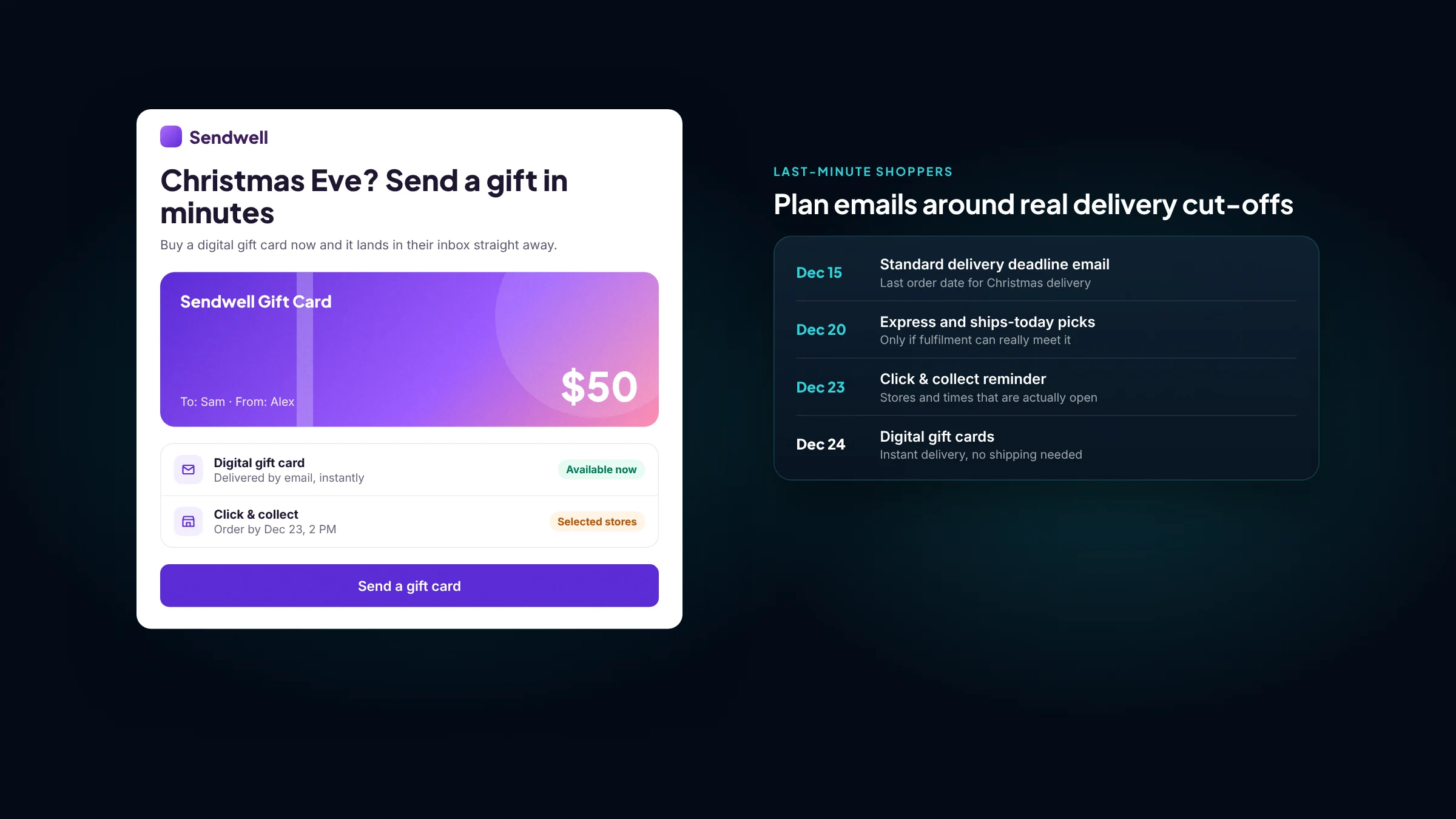
Last-minute holiday campaigns can encourage customers to complete purchases by highlighting products that are available for immediate dispatch, local collection, digital delivery, or other suitable fulfillment options.
However, delivery promises must be accurate. A business should never advertise guaranteed Christmas delivery unless its fulfillment operations can genuinely support that commitment.
How to implement this strategy:
- Clearly communicate the final order dates for holiday delivery.
- Promote products available for immediate dispatch.
- Highlight click-and-collect options where available.
- Recommend digital gift cards for last-minute shoppers.
- Share estimated delivery windows.
- Send order and shipping updates after purchases.
- Explain what happens if a delivery deadline is missed.
Example: A digital gift card company can launch a Christmas Eve email campaign featuring instant gift delivery. The message can explain that customers can purchase a gift card online and send it directly to the recipient's inbox.
For physical retailers, a last-minute campaign could highlight products available for same-day collection or local delivery, provided those services are actually available.
Timing matters here. An email sent too late may be ineffective, so businesses should plan delivery-related campaigns around their actual fulfilment capacity.
12. Follow Up After the Holidays to Build Long-Term Customer Relationships
Many businesses concentrate so heavily on generating holiday sales that they overlook what happens after the shopping season ends. However, post-holiday communication can be just as valuable as pre-holiday promotions.
Customers who purchase during November and December have already demonstrated interest in a business. Following up with useful information, relevant recommendations, and thoughtful offers can help turn these seasonal buyers into repeat customers.
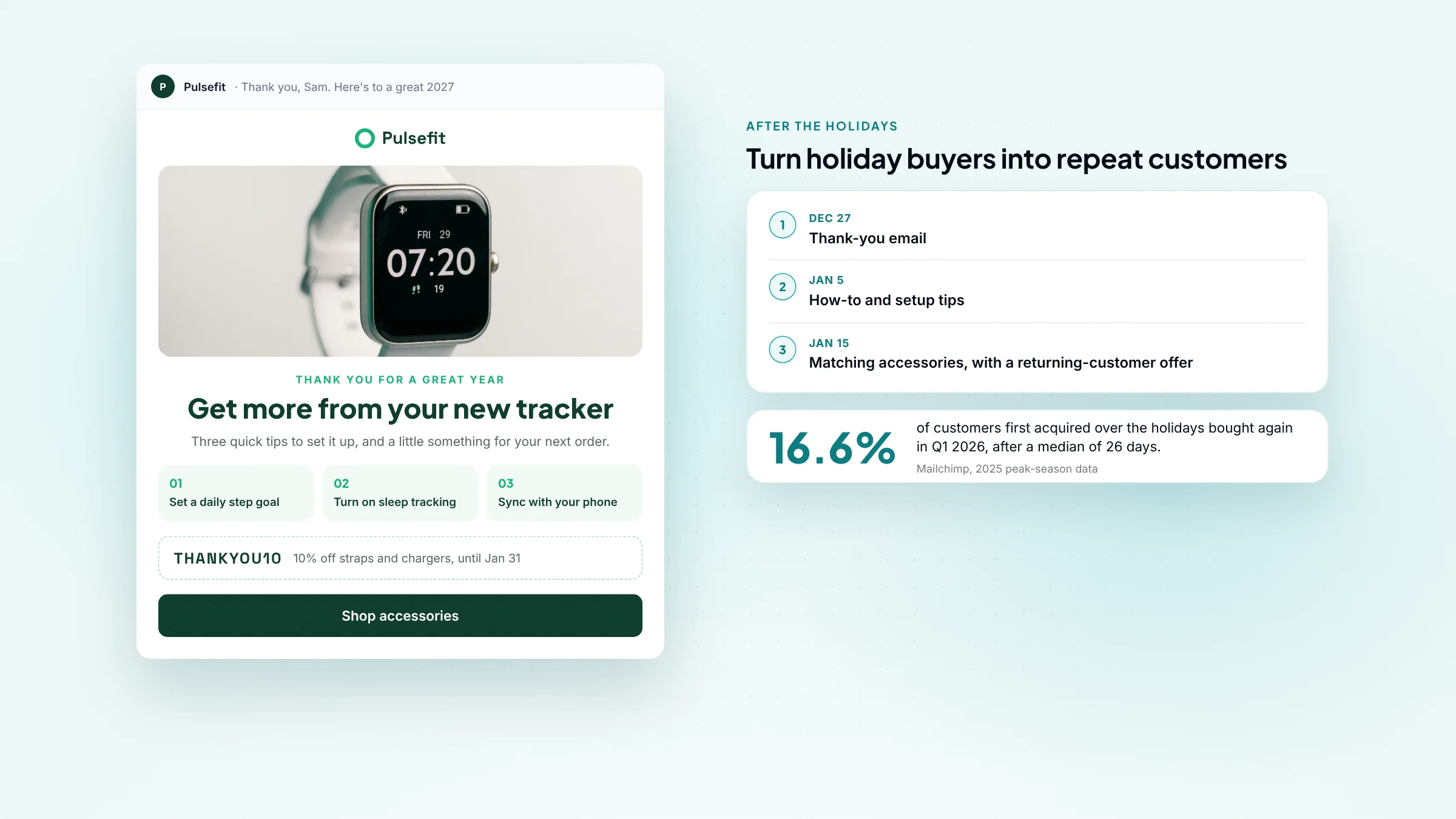
Mailchimp's analysis of its 2025 peak-season customer activity found that 16.6% of customers acquired during the holiday period made another purchase in the first quarter of 2026. Among those returning customers, the median time to their next purchase was 26 days. This provides a strong reason to continue nurturing customers after the initial holiday transaction.
How to implement this strategy:
- Send thank-you emails after holiday purchases.
- Request customer feedback and product reviews.
- Share helpful product usage tips.
- Recommend complementary products.
- Introduce New Year collections and promotions.
- Offer loyalty rewards to returning customers.
- Re-engage customers who purchased only once.
Example: A customer purchases a fitness tracker during a Christmas promotion. In January, the business can send a follow-up email explaining how to use its tracking features, followed by recommendations for compatible accessories.
A food retailer could send customers recipes featuring products they purchased during the holiday season. A clothing brand could introduce its winter-to-spring collection to customers who bought seasonal apparel.
The objective is to maintain a meaningful connection rather than immediately sending another discount.
“The holiday season should be the beginning of a stronger customer relationship, not the end of a promotional calendar. Businesses that continue communicating with customers after a purchase create more opportunities for long-term growth.”
- Sebastian Stokkendal, Owner & CEO of Messaro
Additional Best Practices for Holiday Email Marketing in 2026
The 12 strategies above can help businesses create stronger holiday campaigns, but successful execution also depends on planning, technical preparation, and continuous performance monitoring.
Here are five additional considerations that businesses should include in their holiday marketing plans.
1. Maintain a Consistent Sending Schedule
Sending too many emails can overwhelm subscribers, while sending too few can make a brand easy to forget. Businesses should develop a schedule that balances promotional messages with useful content. For more on finding that balance, see how often to send marketing emails.
For example, an ecommerce business might send two promotional emails per week in October, increase its frequency during Black Friday week, and reduce promotional messages after Christmas.
The schedule should also account for customer engagement and previous campaign performance.
2. Protect Email Deliverability
A well-designed email cannot generate results if it never reaches the intended inbox. Businesses should maintain clean subscriber lists, authenticate their sending domains, monitor spam complaints, and remove invalid addresses. The practical steps are covered in how to improve inbox placement and email deliverability.
Important technical measures include:
- SPF (Sender Policy Framework).
- DKIM (DomainKeys Identified Mail).
- DMARC (Domain-based Message Authentication, Reporting and Conformance).
- Appropriate unsubscribe functionality.
- Regular monitoring of bounce and complaint rates.
Google and Yahoo have introduced sender requirements that make authentication and responsible sending practices particularly important for bulk email marketers.
3. Make Every Call to Action Clear
Every promotional email should have a specific purpose. Whether the objective is to sell a product, introduce a collection, or encourage subscribers to explore an offer, the call to action should communicate what happens next.
Avoid using too many competing buttons. Instead, highlight the most important action and make it easy to identify.
4. Measure Revenue Instead of Focusing Only on Opens
Open rates can provide useful context, but they should not be the only measure of campaign success.
Businesses should evaluate:
| Metric | What It Measures |
|---|---|
| Delivery rate | Percentage of emails successfully delivered |
| Click-through rate | Percentage of delivered emails generating clicks |
| Conversion rate | Percentage of recipients completing the desired action |
| Revenue per recipient | Revenue generated relative to the number of recipients |
| Unsubscribe rate | Percentage of subscribers leaving the list |
| Bounce rate | Percentage of emails that could not be delivered |
| Return on investment | Financial return relative to campaign expenditure |
These metrics help businesses understand whether their messages are generating meaningful engagement and commercial results.
For context, the DMA's 2026 International Email Benchmark reported a global acceptance rate of 98.6%, a unique open rate of 34.2%, and a click-through rate of 3%. These are broad industry figures, not guaranteed targets for every holiday campaign.
5. Use AI to Simplify Campaign Creation
AI is changing how businesses plan and execute email marketing. Instead of manually creating every campaign from scratch, marketers can use AI-assisted tools to develop subject lines, generate content ideas, draft promotional copy, and explore different design concepts.
However, AI-generated content should always be reviewed before publication. Businesses need to verify product details, pricing, promotional conditions, delivery dates, and brand messaging.
The objective should be to reduce repetitive work while preserving the creativity and human understanding that make marketing messages effective.
A Practical Holiday Email Marketing Calendar for 2026
Planning campaigns in advance makes it easier to coordinate promotions, prepare creative materials, and avoid last-minute mistakes. Businesses can use the following calendar as a starting point and adjust it according to their industry, audience, and regional holidays.
| Period | Campaign Focus | Suggested Email |
|---|---|---|
| October 1–15 | Early awareness | Holiday collection previews |
| October 16–31 | Subscriber growth | Early access and gift guides |
| November 1–15 | Seasonal promotions | Product recommendations and special offers |
| November 16–30 | Peak shopping | Black Friday and Cyber Monday campaigns |
| December 1–10 | Christmas shopping | Gift guides and festive bundles |
| December 11–20 | Purchase urgency | Shipping deadlines and last-minute offers |
| December 21–25 | Final holiday communication | Digital gift cards and holiday greetings |
| December 26–31 | Post-Christmas engagement | Thank-you messages and year-end offers |
| January 1–15, 2027 | Customer retention | New Year promotions and product recommendations |
This calendar should not be treated as a requirement to email subscribers every day. Businesses should consider audience preferences, previous engagement, campaign performance, and unsubscribe activity when deciding how frequently to send messages.
For brands operating internationally, it is also important to adapt campaigns to local holidays, cultural expectations, and delivery schedules.
How Messaro Helps Businesses Manage Holiday Email Marketing
Executing successful holiday campaigns requires more than creative ideas. Businesses also need reliable technology to manage subscribers, design emails, schedule campaigns, automate follow-ups, and maintain customer conversations.
Managing these activities across multiple platforms can become complicated, particularly for small businesses and growing marketing teams. Switching between different applications also creates unnecessary work and makes it harder to maintain consistent communication.
This is where Messaro can help.
Messaro is a single platform where businesses can run SMS campaigns, build and send emails, automate follow-ups, and manage all customer conversations from one dashboard. It is simple, affordable, and built to help teams of any size market like the big players.
Here is how businesses can use Messaro to simplify their holiday marketing activities:
1. Build and Send Holiday Emails
Businesses can create promotional emails for Black Friday, Cyber Monday, Christmas, and New Year's campaigns. They can organise seasonal content, communicate special offers, and send marketing messages to their subscribers.
2. Automate Customer Follow-Ups
Automated workflows help businesses maintain communication without manually sending every message. For example, they can create follow-ups for new subscribers, abandoned shopping carts, and customers who have recently made purchases.
3. Manage SMS Campaigns
Businesses can complement their email promotions with SMS campaigns. Important updates, exclusive offers, and time-sensitive reminders can reach customers through another communication channel, provided they have the required consent.
4. Manage Customer Conversations
Messaro brings customer communication activities together through one platform. Businesses can manage their marketing activities and customer conversations without constantly switching between separate applications.
5. Support Growing Marketing Teams
Small businesses do not always have the resources to manage multiple marketing tools. A consolidated platform can simplify workflows, reduce operational complexity, and make it easier to maintain consistent customer communication.
For businesses looking to implement effective holiday email marketing campaign strategies, having the right platform can make campaign execution considerably easier.
Explore Messaro to discover how its email marketing, SMS campaigns, and automation capabilities can support your business.
Final Thoughts
Holiday marketing in 2026 is about more than competing through discounts and promotional offers. Businesses need to understand their customers, communicate at the right time, and provide relevant experiences throughout the shopping journey.
The 12 holiday email marketing campaign strategies discussed in this article offer a practical starting point for building stronger seasonal campaigns. From early-bird promotions and audience segmentation to abandoned-cart recovery and post-holiday retention, each approach addresses a different stage of the customer journey.
The most effective holiday email marketing campaign strategies combine personalisation, thoughtful design, automation, and consistent communication. Businesses should also pay attention to customer preferences rather than overwhelming subscribers with repetitive promotional messages.
Another important consideration is choosing technology that supports these activities without making campaign management unnecessarily complicated. A reliable email marketing platform can help businesses coordinate their promotions, automate repetitive tasks, and maintain better customer relationships.
Ultimately, the goal of holiday email marketing campaign strategies should not be limited to generating seasonal sales. Businesses should use the holiday period to attract new customers, build trust, encourage repeat purchases, and create relationships that continue well into 2027.
With proper planning, useful content, and a platform like Messaro, businesses can approach the 2026 holiday season with greater confidence and turn seasonal opportunities into long-term growth.