
 Sebastian Stokkendal
In This Article▼
Businesses today have more ways than ever to connect with customers. From social media advertising and email campaigns to mobile messaging and app-based engagement, marketers are constantly searching for channels that produce measurable returns. Among the most effective communication methods are SMS marketing and push notifications. Both offer direct access to customers on their mobile devices, yet they differ significantly in terms of reach, engagement, cost, and overall effectiveness.
As businesses prepare their marketing strategies for 2026 and 2027, understanding the differences between these channels is essential. The debate around SMS vs. Push Notifications is no longer just about delivery methods. It is about customer behavior, technology trends, privacy regulations, and return on investment.
Whether you operate an e-commerce store, local business, SaaS company, healthcare practice, or enterprise organization, choosing the right communication channel can significantly impact your marketing results. This guide explores the strengths, limitations, costs, and performance metrics of both channels to help determine which delivers the best ROI in the years ahead.
Understanding SMS Marketing
SMS marketing involves sending text messages directly to customers through their mobile phone numbers. These messages can include promotions, appointment reminders, order updates, event notifications, and customer service communications.
Unlike many digital marketing channels, SMS does not require internet access or a specific application. As long as a customer has a mobile phone and has opted in to receive messages, businesses can communicate instantly.
Several factors contribute to SMS marketing's continued popularity:
- Universal mobile accessibility
- Immediate message delivery
- High visibility
- Strong engagement rates
- Direct customer communication
Because nearly every mobile device supports text messaging, SMS remains one of the most reliable channels for reaching customers quickly.
Understanding Push Notifications
Push notifications are messages sent through mobile applications or web browsers. These notifications appear on a user's device screen even when the application is not actively open.
Companies use push notifications for:
- Product announcements
- Flash sales
- Content updates
- Cart abandonment reminders
- User engagement campaigns
- Personalized recommendations
Push notifications depend on users installing an app or enabling browser notifications. While this creates certain limitations, it also provides opportunities for highly personalized and interactive experiences.
The discussion surrounding SMS vs. Push Notifications often begins with accessibility because this factor significantly influences campaign reach.
The Mobile Marketing Landscape in 2026-27
Mobile usage continues to dominate digital activity worldwide. Industry forecasts suggest that smartphone users will exceed 7 billion globally by 2027. Mobile commerce, mobile banking, and app-based services continue to grow rapidly.
Several trends are shaping communication strategies:
- Increased privacy regulations
- Growing demand for personalization
- AI-powered automation
- Real-time customer engagement
- Omnichannel marketing integration
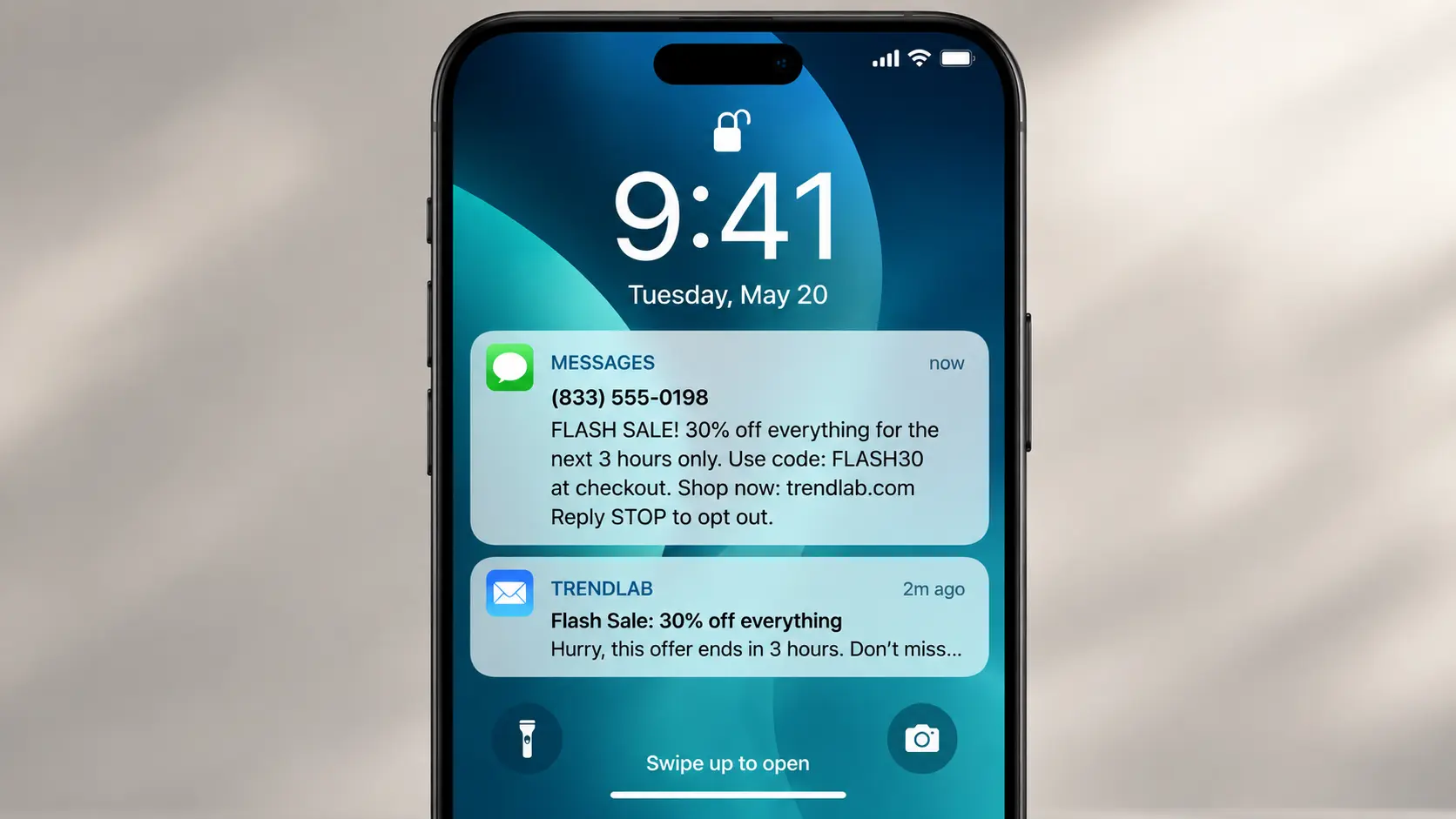
As these trends evolve, marketers must evaluate SMS vs. Push Notifications based on measurable outcomes rather than assumptions.
Reach and Audience Accessibility
One of the biggest differences between SMS and push notifications involves audience reach.
SMS has a distinct advantage because it only requires a phone number. Customers do not need to install an application or maintain active browser permissions.
Push notifications face additional requirements:
- App installation
- Notification permissions
- Device settings that allow alerts
Research consistently shows that many users disable app notifications after installation. Others uninstall apps entirely after limited use.
When evaluating SMS vs. Push Notifications, SMS generally offers broader accessibility because nearly every customer with a mobile phone can receive messages. For businesses targeting a diverse audience, this reach advantage often translates into stronger campaign performance.
Open Rates and Visibility
Open rates remain one of the strongest indicators of engagement.
SMS consistently outperforms most digital channels in this category. Industry studies frequently report SMS open rates between 95% and 98%, with many messages viewed within minutes of delivery.
Push notifications perform well compared to email but typically achieve lower visibility than SMS. Open rates vary significantly based on industry, audience behavior, and app usage patterns.
| Channel | Typical Open Rate |
|---|---|
| SMS | 95–98% |
| Push Notifications | 20–60% |
| 20–40% |
The comparison of SMS vs. Push Notifications clearly highlights SMS as the leader in visibility and immediate attention.
Customer Engagement Metrics
Engagement extends beyond message opens. Businesses measure:
- Click-through rates
- Conversions
- Purchases
- App sessions
- Customer responses
SMS messages often generate high engagement because recipients view them as personal communications rather than promotional content.
Push notifications can also drive engagement, especially when users actively interact with an application. However, engagement levels depend heavily on user behavior. If customers rarely open an app, even well-crafted push campaigns may underperform.
When considering SMS vs. Push Notifications, businesses should analyze how frequently their audience interacts with mobile applications.
Cost Comparison
Cost is a major factor when evaluating marketing ROI. SMS typically involves per-message fees charged by service providers. Costs vary depending on country, volume, and messaging requirements. Push notifications are generally less expensive because businesses can send unlimited notifications through their apps after infrastructure is established.
SMS Costs
- Message delivery fees
- Compliance management
- Platform subscriptions
- Phone number acquisition
Push Notification Costs
- App development
- Notification infrastructure
- User acquisition expenses
- App maintenance costs
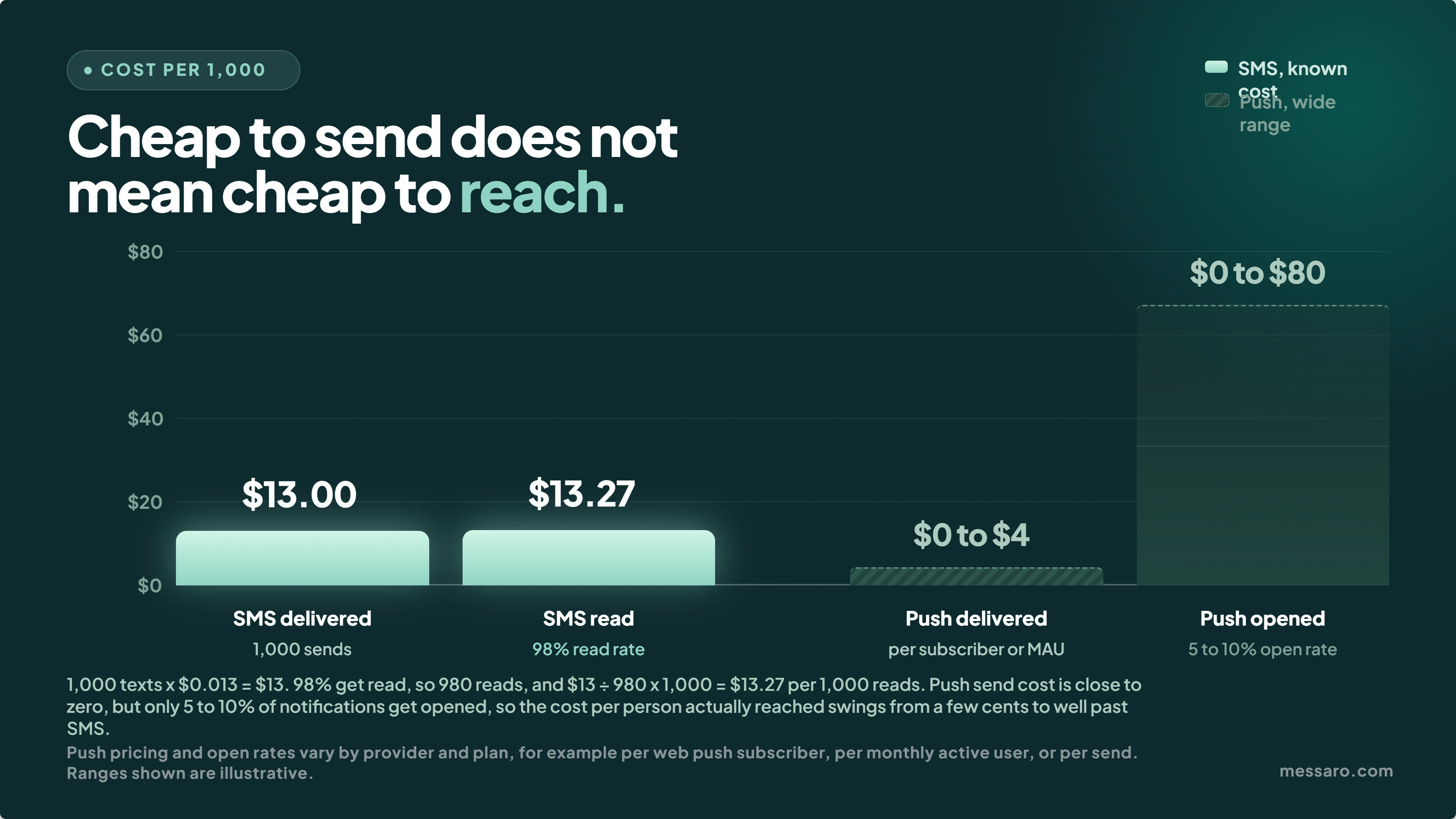
At first glance, push notifications appear cheaper. However, ROI depends on results rather than costs alone. The SMS vs. Push Notifications debate becomes more nuanced when conversion rates enter the equation.
Conversion Performance
High engagement often leads to higher conversions. SMS campaigns frequently generate stronger conversion rates because messages are viewed immediately and create urgency. Examples include:
- Limited-time offers
- Appointment confirmations
- Cart recovery messages
- Event reminders
Push notifications perform well when users already have strong relationships with an app - such as food delivery services, banking platforms, fitness applications, and e-commerce loyalty programs.
In many industries, SMS campaigns produce higher conversion rates despite higher per-message costs.
Personalization Capabilities
Modern customers expect personalized experiences. SMS personalization may include:
- Customer names
- Purchase history
- Appointment information
- Location-based offers
Push notifications offer even deeper personalization because they can access app behavior data. Businesses can trigger notifications based on browsing activity, product views, app interactions, and user preferences.
When analyzing SMS vs. Push Notifications, push notifications often provide more sophisticated personalization opportunities. However, personalization only delivers value if messages are actually seen.
Speed and Urgency
Timing plays a critical role in marketing success. SMS excels when immediate action is required. Examples include:
- Emergency alerts
- Flash sales
- Appointment reminders
- Delivery updates
Because text messages appear directly in messaging inboxes, they often receive attention within minutes. Push notifications can also deliver instantly, but visibility depends on device settings and user preferences.
For time-sensitive campaigns, SMS vs. Push Notifications comparisons often favor SMS due to its reliability and immediacy.
User Trust and Perception
Consumer perception influences campaign effectiveness. SMS messages are often viewed as important communications. Many consumers associate text messages with family, friends, banks, healthcare providers, and trusted businesses.
Push notifications can sometimes feel intrusive, especially when sent excessively. Common complaints include:
- Notification fatigue
- Irrelevant messaging
- Excessive frequency
- Promotional overload
In discussions about SMS vs. Push Notifications, trust often becomes an overlooked factor that directly impacts customer response rates.
Statistics That Matter in 2026-27
Several industry statistics help illustrate channel performance:
- More than 90% of adults own a mobile device
- SMS open rates regularly exceed 95%
- Most SMS messages are read within three minutes
- Push notification opt-in rates vary between 30% and 70% depending on platform and industry
- Personalized mobile campaigns can improve conversion rates by over 20%
- Cart abandonment recovery campaigns using SMS frequently outperform email-based recovery efforts
These numbers demonstrate why marketers continue evaluating SMS vs. Push Notifications as key components of mobile marketing strategies.
Industry-Specific Performance
Retail and E-Commerce
SMS often drives immediate purchases through promotions and flash sales. Push notifications help maintain ongoing customer engagement within shopping apps.
Healthcare
SMS remains highly effective for appointment reminders and patient communication.
Financial Services
Banks frequently use SMS for authentication and security alerts.
SaaS Companies
Push notifications work well for product updates and user engagement.
Hospitality
Hotels and travel providers benefit from both channels depending on communication goals.
Omnichannel Strategies Deliver the Best Results
Many marketers approach SMS vs. Push Notifications as an either-or decision. In reality, the highest-performing organizations increasingly use both channels together.
An omnichannel approach allows businesses to communicate with customers based on context, urgency, and customer preferences. For example:
- Use SMS for order confirmations and time-sensitive promotions
- Use push notifications for app engagement and personalized recommendations
- Combine both channels with email marketing for maximum reach
- Create automated workflows that trigger different messages based on customer actions
A customer who ignores a push notification may respond to an SMS reminder. Similarly, users who actively engage with an app may prefer push notifications over text messages.
The future of mobile marketing is not simply choosing one channel. It is building coordinated communication strategies that deliver the right message at the right moment.
Privacy Regulations and Compliance
Privacy continues to shape digital marketing practices worldwide. Governments and regulatory bodies are introducing stricter requirements related to customer consent, data collection, and communication preferences.
SMS marketing typically requires explicit opt-in consent. Businesses must maintain accurate records of permissions and provide clear opt-out options.
Push notifications also require user consent, although the process usually occurs during app installation or browser setup.
As privacy expectations increase, businesses evaluating SMS vs. Push Notifications must prioritize transparency and compliance. Organizations that respect customer preferences generally achieve better engagement and stronger long-term ROI.
AI and Automation Are Changing Everything
Artificial intelligence is transforming both SMS and push notification campaigns. Modern marketing platforms can now:
- Predict optimal send times
- Personalize content automatically
- Segment audiences dynamically
- Analyze customer behavior in real time
- Trigger automated campaigns
AI helps marketers improve results regardless of channel. For SMS campaigns, AI can identify the best time to send offers and reminders. For push notifications, AI can determine which users are most likely to engage with specific content.
The evolution of AI makes the SMS vs. Push Notifications discussion even more interesting because technology continues to improve performance on both sides.
Common Mistakes Businesses Make
Common SMS Mistakes
- Sending messages too frequently
- Ignoring personalization
- Using unclear calls to action
- Failing to segment audiences
Common Push Notification Mistakes
- Excessive notifications
- Generic messaging
- Poor timing
- Irrelevant content
When businesses compare SMS vs. Push Notifications, they often overlook execution quality. A well-designed campaign on either channel will outperform a poorly managed campaign on the other.
Measuring ROI Effectively
To determine which channel delivers stronger returns, businesses should track:
- Open rates
- Click-through rates
- Conversion rates
- Revenue generated
- Customer retention
- Lifetime value
- Cost per acquisition
Reports
Campaign performance and analytics
142
Total created
512,480
Total sent
98,240
Total received
19.2%
Average
Performance by Type
Response rates by campaign type
Response Trends
Performance over time
Top Performing Campaign
Best based on response rate
Summer Kickoff
March 5th, 2026
25.7%
Response Rate
12,480
Sent
3,210
Responses
99.2%
Delivery
SINGLE
Type
Many organizations focus exclusively on delivery costs while ignoring revenue impact. A campaign that costs more but generates significantly higher conversions may produce better overall ROI. This is why the question of SMS vs. Push Notifications cannot be answered solely through cost analysis - businesses must evaluate both expenses and outcomes.
When SMS Is the Better Choice
SMS typically delivers superior ROI when:
- Immediate action is required
- Customer reach is critical
- App adoption is low
- Time-sensitive communications are necessary
- Customer engagement needs to be guaranteed
Examples include flash sales, appointment reminders, payment notifications, emergency communications, and delivery updates. In these situations, SMS vs. Push Notifications comparisons often favor SMS because of its reliability and visibility.
When Push Notifications Are the Better Choice
Push notifications often provide stronger value when:
- Users actively engage with an app
- Frequent messaging is required
- Budget constraints are significant
- Behavioral targeting is important
- Ongoing customer engagement is the primary goal
Examples include daily app activity reminders, product recommendations, content updates, loyalty program engagement, and feature announcements. These scenarios demonstrate that SMS vs. Push Notifications should be evaluated based on specific business objectives rather than general assumptions.
The ROI Winner for 2026-27
So which channel delivers better ROI? The answer depends on business goals, customer behavior, and communication strategy.
However, when evaluating pure reach, visibility, engagement, and conversion potential, SMS continues to hold a significant advantage. Key reasons include:
- Nearly universal accessibility
- Exceptionally high open rates
- Faster customer response times
- Strong conversion performance
- Greater reliability for urgent communication
Push notifications remain valuable and cost-effective, especially for app-based businesses. Yet they face limitations related to app adoption, notification permissions, and user engagement.
For organizations focused on direct response marketing, customer retention, and revenue generation, SMS is likely to deliver stronger returns throughout 2026 and 2027. The most successful brands will not view SMS vs. Push Notifications as a battle with a single winner. Instead, they will leverage both channels strategically while recognizing that SMS often provides the strongest foundation for high-ROI mobile communication.
Partner With Messaro for Powerful SMS Marketing
If you want to leverage SMS for your business marketing, choose Messaro. We provide reliable, scalable, and results-driven SMS solutions designed to help businesses connect with customers instantly.
Our platform enables businesses to create targeted campaigns, automate customer communication, send time-sensitive promotions, and improve engagement through direct mobile messaging. Whether you operate a small business, a growing e-commerce store, a healthcare practice, a financial institution, or an enterprise organization, we deliver the tools needed to maximize the value of SMS marketing.
At Messaro, we understand that successful communication requires more than simply sending messages. Our solutions focus on deliverability, automation, personalization, compliance, and measurable performance. We help businesses reach customers where they are most active and drive meaningful actions that contribute to long-term growth.
As mobile marketing continues evolving through 2026 and 2027, our SMS services provide the reliability, reach, and engagement businesses need to stay competitive. By partnering with Messaro, you gain access to a trusted platform built to support stronger customer relationships, higher conversions, and improved marketing ROI. Contact us today!
FAQs
Which has a higher open rate, SMS or push notifications?
SMS generally has a significantly higher open rate, often exceeding 95%, while push notification open rates typically range between 20% and 60% depending on the industry and user behavior.
Are push notifications cheaper than SMS marketing?
Yes. Push notifications are usually less expensive because there are no per-message carrier fees. However, lower costs do not always translate into higher ROI.
Is SMS marketing still effective in 2026 and 2027?
Absolutely. SMS remains one of the most effective communication channels due to its high visibility, fast delivery, and strong engagement rates.
Can businesses use SMS and push notifications together?
Yes. Many successful businesses combine both channels within an omnichannel marketing strategy to maximize customer engagement and conversions.
Which channel is best for urgent communications?
SMS is generally the better choice for urgent communications because messages are delivered directly to customers and are usually read within minutes of receipt.